Affiliate disclosure: Fit For Your Dog may earn a commission from qualifying purchases made through certain links on this page, at no additional cost to you.
As an Amazon Associate I earn from qualifying purchases.
Editorial note: This is a research-based buying guide. We compared manufacturer specifications, fit guidance, harness features, and available product information. We have not personally tested these seven harnesses. Product availability, colors, sizes, and pricing may change.
Finding the best dog harnesses for large dogs takes more than choosing the biggest size on the shelf. A harness that works for a calm Labrador may be a poor match for a powerful puller, an escape-prone rescue dog, or a deep-chested German Shepherd.
The right harness should distribute pressure comfortably, offer useful leash control, stay secure without restricting movement, and fit your dog’s actual measurements. It should also match how you use it: neighborhood walks, training sessions, hiking, or traveling by car.
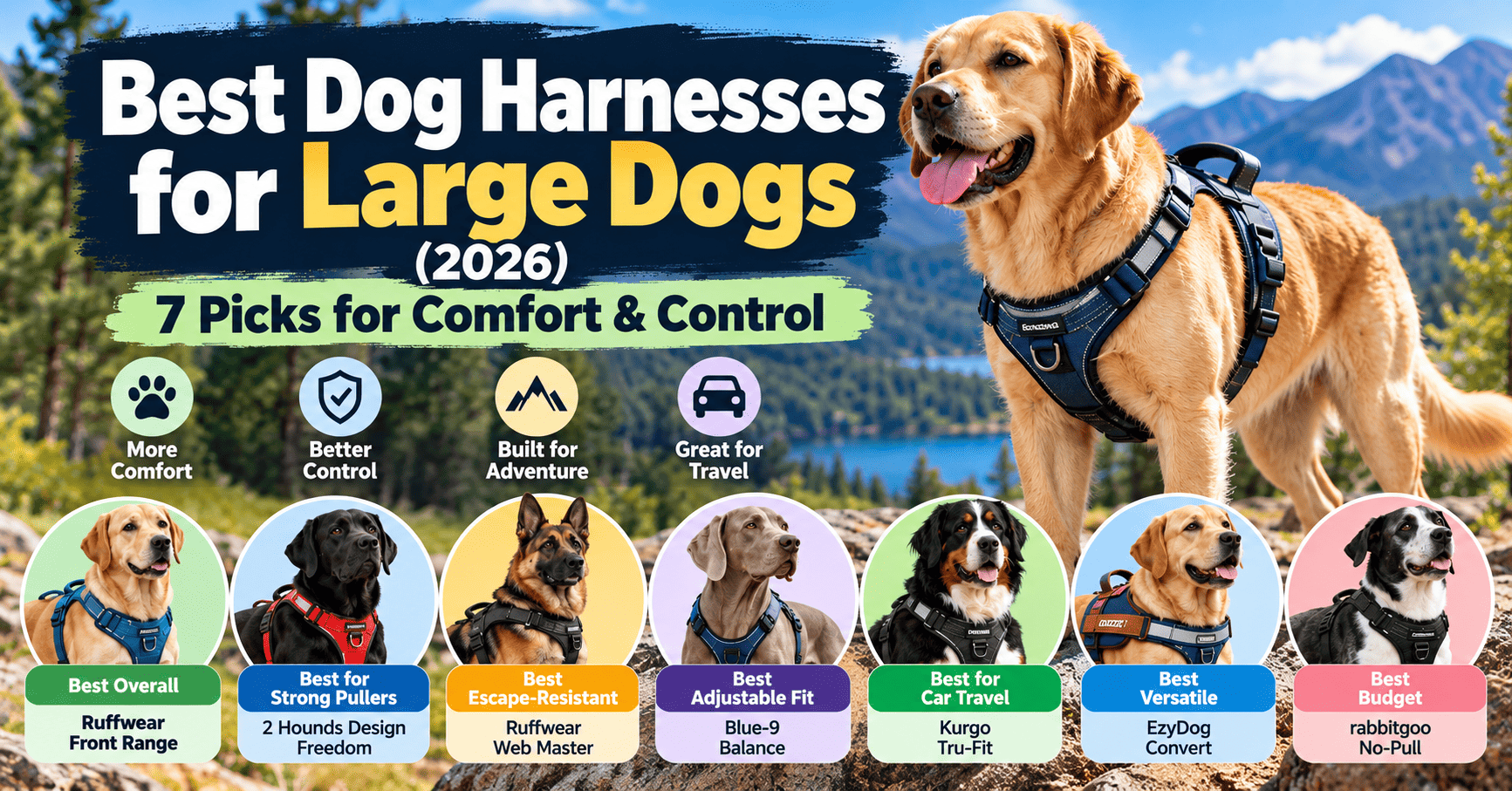
For this 2026 guide, we narrowed the field to seven harnesses with distinct strengths. Our best overall pick is the Ruffwear Front Range for its balanced everyday design, while the 2 Hounds Design Freedom is particularly worth considering for dogs that pull. The other picks address escape resistance, precise adjustment, car travel, rugged outdoor use, and budget-friendly walking.
Important: A “no-pull” harness is a training aid, not a substitute for teaching loose-leash walking. Similarly, a walking harness should never be assumed to provide crash protection in a vehicle.
Quick Picks: Best Dog Harnesses for Large Dogs
- Best Overall: Ruffwear Front Range — padded everyday comfort with front and back leash attachments.
- Best for Strong Pullers: 2 Hounds Design Freedom No-Pull — dual connection points and a distinctive martingale-style back loop.
- Best Escape-Resistant: Ruffwear Web Master — three-strap construction and an assistance handle.
- Best Adjustable Fit: Blue-9 Balance Harness — six adjustment points and an open, minimal-coverage design.
- Best for Car Travel: Kurgo Enhanced Strength Tru-Fit — a car-oriented harness with manufacturer-documented crash testing up to 75 lb.
- Best Versatile Outdoor Harness: EzyDog Convert — rugged design, traffic handle, and optional accessories.
- Best Budget: rabbitgoo No-Pull Harness — padded construction and two leash attachment points at a generally accessible price tier.
Comparison Table: 7 Large-Dog Harnesses
| Harness | Best For | Standout Feature | Main Trade-Off |
|---|---|---|---|
| Ruffwear Front Range | Everyday walks | Four adjustment points and dual leash connections | Not designed as an escape-specialist harness |
| 2 Hounds Freedom | Strong pullers | Front/back connections and martingale-style back loop | Fit and leash setup take practice |
| Ruffwear Web Master | Escape-prone dogs | Three-strap body design with padded handle | More coverage and bulk |
| Blue-9 Balance | Fine-tuned fit | Six adjustment points | Minimal padding |
| Kurgo Enhanced Strength Tru-Fit | Car travel within tested limits | Manufacturer-documented testing up to 75 lb | Testing does not extend to heavier dogs |
| EzyDog Convert | Outdoor walks and close control | Rugged body and traffic handle | Front leash attachment requires an optional accessory |
| rabbitgoo No-Pull | Budget-conscious everyday use | Front/back leash clips and padding | Less specialized than premium designs |
Comparison is based on the features and limitations documented for each model. These are editorial recommendations, not results from hands-on performance testing.
Detailed Reviews: Our 7 Picks
1. Ruffwear Front Range — Best Overall
The Ruffwear Front Range is our leading all-around choice for large dogs that need a comfortable, practical harness for regular walks. It combines a foam-padded body with four adjustment points, reflective trim, and two leash attachment locations.
The aluminum V-ring on the back works well for ordinary walking when your dog is already reasonably comfortable on leash. The reinforced connection at the chest provides another option when you need help redirecting a dog that tends to pull forward.
This flexibility is the Front Range’s biggest advantage. Rather than buying one harness for daily outings and another for basic leash training, many owners can start with this model and adjust their setup as their dog’s skills improve.
Ruffwear also includes an identification pocket and a light attachment loop. These are useful extras, though reflective details and lights should not replace an attentive handler or appropriate visibility precautions.
Large-dog fit: The manufacturer’s Large/X-Large size covers a chest girth of approximately 32–42 inches. Measure behind the front legs before choosing a size.
Pros
- Two leash attachment options for different walking needs.
- Foam padding and multiple adjustment points.
- Reflective trim and practical everyday details.
Cons
- Not the most specialized option for dogs that repeatedly back out of harnesses.
- Large dogs with unusual proportions may need a different fit profile.
Our verdict: The best starting point for an owner who wants one well-rounded harness for comfortable daily walks, light adventures, and basic leash-control work.
Check Price on Amazon(paid link)
2. 2 Hounds Design Freedom No-Pull — Best for Strong Pullers
The 2 Hounds Design Freedom No-Pull Harness is worth a close look for large, powerful dogs that turn ordinary walks into a tug-of-war. Unlike basic back-clip harnesses, it incorporates both front and rear connection points along with a martingale-style loop on the back.
The front attachment can help redirect the dog toward the handler rather than allowing every forward pull to become a straight-line contest of strength. The rear loop offers another control option, and the manufacturer offers compatible double-connection training arrangements.
Comfort is also part of the design. Swiss velvet lining behind the front legs is intended to reduce rubbing in an area where active dogs can experience friction. The harness uses sturdy webbing and metal components rather than relying on a bulky padded vest.
However, it is important to understand what the product cannot do. It does not teach a dog to walk politely by itself. Owners should reward slack-leash behavior and practice in manageable environments.
Large-dog fit: The selected Large listing showed a chest range of approximately 28–32 inches. Larger dogs may need XL or XXL, so use the manufacturer’s measurement chart rather than choosing by breed name alone.
Pros
- Front and rear leash attachment points.
- Designed for leash management with strong dogs.
- Soft lining at common friction points.
Cons
- Correct adjustment and leash handling require attention.
- A separate training leash may be needed for some configurations.
- No harness eliminates the need for consistent training.
Our verdict: Our preferred choice when pulling is the primary problem and the owner is willing to combine appropriate equipment with positive, consistent leash training.
Check Price on Amazon(paid link)
3. Ruffwear Web Master — Best Escape-Resistant
Some large dogs have mastered an unfortunate skill: backing out of a conventional harness when startled or reluctant to move. The Ruffwear Web Master addresses that problem through a three-strap body design that offers additional retention around the torso.
Compared with the Front Range, the Web Master provides more body coverage and a reinforced padded handle. Ruffwear also includes adjustable straps and multiple leash attachment locations, allowing owners to fine-tune how the harness sits.
This combination can be particularly valuable for dogs with narrow waists, escape-prone behavior, or a need for occasional controlled assistance over obstacles. The handle is a useful aid, but owners should follow the manufacturer’s instructions and avoid assuming any harness can safely support every type of lifting maneuver.
One important trade-off is bulk. The additional body structure that contributes to retention also makes the Web Master more substantial than minimal-strap harnesses. Check that it allows comfortable shoulder movement and does not create unnecessary heat or rubbing.
Large-dog fit: Ruffwear’s Large/X-Large size is listed for a girth of 32–42 inches. A secure fit is essential; even an escape-resistant design is not escape-proof.
Pros
- Three-strap design for added retention.
- Padded assistance handle.
- Multiple adjustment and leash attachment options.
Cons
- More body coverage than lightweight harnesses.
- May be unnecessary for dogs that never try to escape.
- Needs careful fitting before use in distracting environments.
Our verdict: Our strongest candidate for owners whose dogs have a history of backing out of ordinary walking harnesses.
Check Price on Amazon(paid link)
4. Blue-9 Balance Harness — Best Adjustable Fit
The Blue-9 Balance Harness takes a different approach to comfort. Instead of adding extensive padding and fabric panels, it uses a relatively open strap system with six points of adjustment.
Those adjustments allow owners to change how the harness sits across the dog’s torso, neck, and chest. This can be especially helpful when a large dog has proportions that do not work well with a conventional padded harness, such as a deep chest or a relatively narrow neck.
The design includes front and rear leash attachments. The buckle-neck configuration is also convenient for dogs that dislike having equipment pulled over their heads.
Another advantage is the relatively unobstructed body shape. Owners can more easily see whether straps are resting in the intended positions. However, minimal padding may not suit every dog, particularly if the harness is adjusted poorly or frequently rubs against sensitive areas.
Large-dog fit: The selected Large listing indicated a rib-cage range of approximately 29–43.5 inches. Because this is a particularly adjustable design, follow the fitting instructions rather than simply tightening every strap as much as possible.
Pros
- Six points of adjustment.
- Front and back leash connections.
- Open design with less fabric coverage.
- Buckle-neck option for head-sensitive dogs.
Cons
- Less padding than vest-style harnesses.
- Getting the initial fit right can take additional time.
Our verdict: A particularly attractive option for large dogs whose body shape makes standard harnesses difficult to fit comfortably.
Check Price on Amazon(paid link)
5. Kurgo Enhanced Strength Tru-Fit — Best for Car Travel
For owners who regularly drive with their dogs, the Kurgo Enhanced Strength Tru-Fit Smart Harness deserves separate consideration. Unlike the typical walking harness, this model is specifically marketed for vehicle restraint as well as ordinary walking.
Kurgo says the Enhanced Strength version was crash-tested for dogs weighing up to 75 pounds. It features metal nesting buckles, five adjustment points, a padded chest section, and an included short tether for vehicle attachment.
That 75-pound limit matters. A large Labrador may fall within the stated test range, while a heavier Rottweiler, Mastiff, or Great Dane may not. We would not extend the manufacturer’s testing claim to dogs above that weight or present it as proof of universal accident protection.
Testing performed or described by a manufacturer is also not the same as an independent safety certification. Owners should read Kurgo’s restraint instructions and any available test documentation before relying on this model for travel.
For walking, the adjustable fit and padded chest help make the harness more versatile, but its main reason for appearing in this guide is its documented car-oriented design.
Pros
- Manufacturer-documented crash testing for dogs up to 75 lb.
- Metal buckles and several adjustment points.
- Includes a short tether for the manufacturer’s prescribed vehicle setup.
Cons
- The stated testing limit does not cover heavier giant-breed dogs.
- Requires correct restraint installation, not simply putting the harness on.
- Not our first choice when walking comfort is the only priority.
Our verdict: A car-travel candidate for dogs within the manufacturer’s documented test limits, provided owners understand the installation instructions and safety limitations.
Check Price on Amazon(paid link)
6. EzyDog Convert — Best Versatile Outdoor Harness
The EzyDog Convert is a rugged alternative for owners who regularly take their large dogs on longer walks, hikes, and outdoor outings. Its design combines a substantial body panel, a soft-touch traffic handle, reflective trim, and a sturdy back leash connection.
The traffic handle is especially useful when you temporarily need to keep your dog close, such as moving past a crowded path or guiding a dog through a narrow space. It should not be treated as a substitute for a secure leash or specialized lifting equipment.
The Convert also supports selected accessories from EzyDog, including compatible saddle bags and an optional UpFront leash attachment. That modular approach makes it versatile for active households.
There is one important distinction: the standard Convert harness should not be described as having a built-in front leash clip equivalent to the Ruffwear Front Range. EzyDog markets the UpFront connection as an additional accessory.
Because the Convert offers more coverage and a tougher exterior, it may be more substantial than necessary for a short neighborhood stroll on a hot day. Fit, ventilation, and activity level should guide the choice.
Pros
- Durable outer construction and padded body.
- Convenient traffic handle.
- Reflective trim and compatible outdoor accessories.
Cons
- Front-attachment functionality requires an optional accessory.
- Bulkier than minimal-strap walking harnesses.
- Not a crash-tested vehicle restraint simply because it looks rugged.
Our verdict: A strong choice for outdoor-focused owners who value a robust harness, close-control handle, and accessory flexibility.
Check Price on Amazon(paid link)
7. rabbitgoo No-Pull Harness — Best Budget
Not every large dog needs a premium-priced harness. The rabbitgoo No-Pull Harness offers many features associated with more expensive walking designs, including a padded body, adjustable straps, reflective details, and two leash attachment points.
Owners can use the rear connection for conventional walks and the front connection as an additional management option when working on leash manners. A top handle gives another point of close control in situations where it is appropriate to use one.
Its appeal is straightforward: everyday walking functionality without committing to a highly specialized harness. For a dog that is already reasonably comfortable on leash, this may provide all the features an owner actually needs.
The trade-off is specialization. Owners with a persistent escape artist, unusual fitting challenges, or a heavy-duty outdoor workload may benefit from the more targeted designs elsewhere in this guide.
Do not rely on the word “Large” alone. The correct fit still depends on the individual dog’s chest and neck measurements, and the straps should be adjusted before the first walk.
Pros
- Budget-friendly alternative with practical features.
- Front and back leash attachment options.
- Padding, reflective details, and adjustable fit.
Cons
- Less specialized than escape-resistant or vehicle-focused harnesses.
- Fit and comfort must be checked carefully, particularly on strong pullers.
Our verdict: A sensible starting option for budget-conscious owners who want a padded, adjustable harness for everyday walks.
Check Price on Amazon(paid link)
How We Chose These Harnesses
Fit For Your Dog uses a research-based editorial process for buying guides that have not involved direct product testing.
For this comparison, we evaluated seven models according to their documented designs, fitting guidance, leash attachment arrangements, construction, and suitability for different large-dog needs.
- Comfort: Placement of straps, padding where appropriate, and the ability to move naturally.
- Fit: Available size ranges and the number and usefulness of adjustment points.
- Control: Front or rear leash attachments, handles, and specialized retention designs.
- Activity match: Everyday walks, training, hiking, or vehicle travel.
- Clear limitations: Whether the design has important restrictions that a buyer should understand.
- Product verification: Comparison of manufacturer documentation with the selected Amazon listings.
We did not measure durability, conduct crash tests, or fit these products on dogs ourselves. Our “best for” distinctions are editorial judgments about suitability, not a claim that one harness has been scientifically proven superior to every competing product.
Availability and return-related information can change. We recommend checking the current product page and return terms before ordering. Affiliate compensation does not determine the stated strengths or limitations of a product.
How to Measure a Large Dog for a Harness
One of the most common harness-buying mistakes is choosing by breed or weight alone. Large dogs can have dramatically different body shapes, even at similar weights.
A broad-chested Boxer, a lean Doberman, and a heavily coated Golden Retriever may all require different strap adjustments. The American Kennel Club recommends measuring the chest and neck and checking the sizing guidance for the exact harness.
Step 1: Measure Chest Girth
Use a flexible measuring tape around the widest portion of your dog’s rib cage, generally behind the front legs. Keep the tape level and snug without compressing the coat or skin.
Step 2: Check Neck Measurements
Some models require a neck circumference measurement in addition to chest girth. Do not assume a harness will fit simply because the chest measurement falls within the advertised range.
Step 3: Compare the Exact Size Chart
There is no universal Large size. A Large in one brand might fit a chest measurement that requires Medium or XL in another. Size charts may also change between product versions.
Step 4: Adjust and Check Movement
Once the harness is on, check for comfortable clearance beneath the straps. A common starting guideline is that roughly two fingers should fit snugly beneath them, but the exact fit depends on the product and the dog’s coat.
Watch your dog walk, turn, sit, and lie down. Look for straps sliding into the armpits, restricting shoulder movement, or moving excessively when the leash is attached.
Step 5: Test Retention Before Busy Walks
In a safe, controlled area, gently check whether the harness could slide forward or backward and potentially slip over the dog’s head. Dogs that retreat when frightened need particular attention to harness retention.
Recheck the fit after grooming, substantial changes in weight, or changes in coat thickness.
Front-Clip vs. Back-Clip Harnesses for Large Dogs
Back-clip harnesses are convenient for everyday walking and often work well with dogs that already maintain a comfortable leash position. However, a strong dog may still lean into the harness and pull forward.
Front-clip harnesses attach the leash at the chest. This arrangement can make redirecting a pulling dog easier for some handlers, but it does not automatically resolve pulling behavior.
Dual-clip harnesses provide both arrangements, allowing owners to select the connection that works best for the dog, walking environment, and training plan.
If your large dog regularly lunges or pulls hard, start leash exercises in a low-distraction environment. Reward moments when the leash is slack and gradually build toward busier locations.
For broader activity planning, see our guide to how much exercise dogs need.
Can You Use a Walking Harness in the Car?
Not all walking harnesses are vehicle restraints. A sturdy appearance, metal hardware, or a convenient back clip does not establish that a harness provides meaningful protection in a collision.
Kurgo publishes crash-testing information for the Enhanced Strength Tru-Fit Smart Harness, with a stated dog-weight limit of 75 pounds. That claim should be read with its full limitations and installation instructions.
A car harness should be evaluated separately from a walking harness, especially for dogs above the stated test weight. Never use a walking leash or a handle as an improvised collision restraint.
For more travel preparation ideas, see our dog road trip checklist. Owners shopping for smaller pets can also review our small-dog car seat comparison, while remembering that car seat marketing claims and crash-test evidence are not interchangeable.
5 Harness Mistakes to Avoid With Large Dogs
- Buying by weight alone: Chest shape and girth often matter more than a broad weight description.
- Assuming “no-pull” means no training: Equipment can help manage a walk, but good leash habits still need to be taught.
- Ignoring chafing: Check the armpits, chest, and other contact areas after the first few outings.
- Choosing more padding without considering temperature: Bulky coverage may be uncomfortable for some dogs in warm conditions.
- Using an ordinary harness as a car restraint: Travel claims require separate evidence and the appropriate installation.
For senior large dogs that also struggle with climbing into vehicles or onto furniture, harness choice is only part of the solution. Our senior-dog ramp comparison covers additional mobility-related equipment.
Frequently Asked Questions
What is the best dog harness for a large dog that pulls?
The 2 Hounds Design Freedom No-Pull is our preferred option for owners focusing on pulling management. Its front and back connection points provide flexible leash setups. It should be paired with consistent loose-leash training rather than treated as an automatic solution.
What harness is best for a large dog that escapes?
The Ruffwear Web Master is our top candidate for escape-prone dogs because of its three-strap body design. However, no harness should be described as completely escape-proof. Proper sizing, adjustments, and supervised fit checks are essential.
Should a large dog wear a harness or a collar?
Both can have a role. A properly fitted harness can provide alternative leash-control options and avoid concentrating all walking pressure at the neck. A collar may still be useful for identification, but your choice should reflect the dog’s behavior, comfort, and any veterinary guidance.
Can a no-pull harness hurt a dog’s shoulders?
A poorly fitted harness can cause rubbing or interfere with comfortable movement, regardless of its marketing category. Check strap position, shoulder freedom, and the dog’s gait. If your dog shows pain, stiffness, skin irritation, or a change in movement, stop using the harness and consult your veterinarian.
What size harness does a 70-pound dog need?
There is no reliable universal size for a dog based only on 70 pounds of body weight. Measure chest girth and any other dimensions required by the manufacturer, then use that specific model’s sizing chart.
Is the Kurgo Enhanced Strength Tru-Fit suitable for dogs over 75 pounds?
Kurgo’s published crash-testing claim applies to dogs up to 75 pounds. We would not assume equivalent collision performance above that weight. Owners of heavier dogs should seek a restraint with appropriate documented testing for their dog’s weight and intended use.
Are expensive dog harnesses always better?
No. Higher-priced models may offer useful specialized designs, materials, or adjustment options, but a correctly fitted, simpler harness may be sufficient for everyday walking. The most useful features depend on your dog’s behavior and intended activities.
Final Verdict: Which Large-Dog Harness Should You Choose?
For most owners looking for a dependable everyday harness, the Ruffwear Front Range offers the most balanced combination of padding, adjustment, and leash attachment options.
Choose the 2 Hounds Design Freedom when pulling management is the main priority, or the Ruffwear Web Master when secure retention matters most. The Blue-9 Balance deserves consideration for dogs requiring especially careful adjustments.
For specific needs, the Kurgo Enhanced Strength Tru-Fit is our car-oriented choice within its documented test limits; the EzyDog Convert is our rugged outdoor option; and the rabbitgoo No-Pull is our budget pick.
The bottom line: The best dog harness for a large dog is the one that fits securely, allows comfortable movement, and addresses your dog’s actual walking or travel needs. A brand name, price, or “no-pull” label can never replace a proper fit.
Sources and Further Reading
Manufacturer information and independent dog-care guidance consulted for this research-based comparison:
- Ruffwear — Front Range harness features and sizing
- 2 Hounds Design — Freedom No-Pull harness
- Ruffwear — Web Master harness design and fit
- Blue-9 — Balance Harness features and adjustments
- Kurgo — Enhanced Strength Tru-Fit testing and features
- EzyDog — Convert harness specifications
- American Kennel Club — Choosing the right dog harness
- American Kennel Club — Loose-leash training guidance
Fit For Your Dog Editorial Team | Research-based product comparison | Updated October 2026