Affiliate disclosure: Fit For Your Dog may earn a commission from qualifying purchases made through certain links on this page, at no additional cost to you.
Disclosure: Fit For Your Dog may earn a commission from eligible purchases made through certain links, at no extra cost to you.
This guide is based on current manufacturer information, specifications, plan details, and published product documentation rather than a controlled hands-on field test.
Read more about our process on How We Review.
Choosing one of the best GPS trackers for dogs depends on more than the size of the device or the advertised battery life. A tracker that works well for a city dog may be a poor fit for a hunting dog in an area with weak cellular coverage, while a premium virtual-fence collar may be unnecessary for someone who only wants escape alerts.
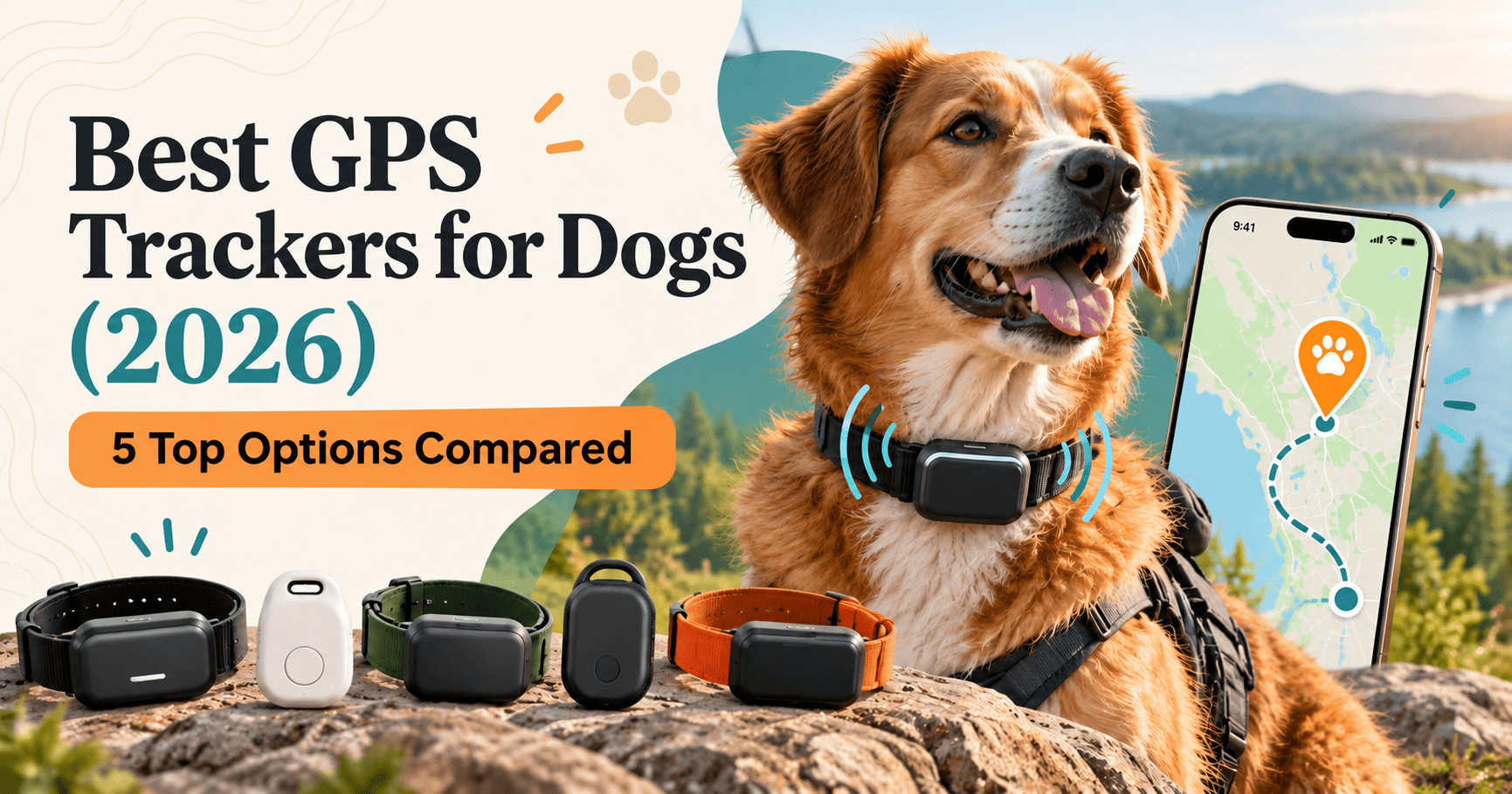
For 2026, we compared five very different tracking options: Tractive DOG 6, Fi Series 3+, Petcube GPS Tracker, Halo Collar 5, and Garmin Alpha TT 25. Together, they cover everyday cellular GPS tracking, long-battery smart collars, lower-cost tracking, virtual fencing, and off-grid field use.
Quick picks
Compact cellular GPS tracking, escape alerts, health features, and up to two weeks of battery life.
An integrated smart collar with GPS/LTE tracking and manufacturer-rated battery life of up to three months.
Lower hardware price, live GPS, virtual fences, light and sound alerts, and up to 30 days in power-save mode.
A premium smart collar combining live location tracking with configurable GPS fences.
VHF-based tracking with up to nine miles of published range when paired with a compatible Garmin handheld.
Best GPS trackers for dogs at a glance
| Tracker | Best for | Published battery | Subscription | Tracking system |
|---|---|---|---|---|
| Tractive DOG 6 | Most dog owners | Up to 2 weeks with Power Saving Zones | Required | GPS + cellular |
| Fi Series 3+ | Long battery life | Up to 3 months | GPS/LTE plan required | GPS + LTE-M |
| Petcube GPS Tracker | Lower hardware cost | Up to 30 days in power-save mode | Required | GPS + LTE/4G |
| Halo Collar 5 | Tracking + virtual fencing | Up to 48 hours | Pack Membership required | GPS + cellular + virtual fence |
| Garmin Alpha TT 25 | Hunting / field use | Up to 68 hours standard; up to 136 hours extended | No cellular subscription for collar tracking | GPS + VHF with compatible handheld |
How we compared these GPS dog trackers
We evaluated current manufacturer specifications and documentation for the features most likely to affect everyday ownership:
- type of location technology;
- cellular or subscription requirements;
- published battery estimates;
- escape alerts and virtual fences;
- water and durability ratings;
- device size and dog-size suitability;
- specialized use cases such as hunting or off-grid tracking;
- current hardware and plan pricing where publicly available.
We have not completed a controlled side-by-side field test of these five products. We therefore do not assign invented accuracy percentages, range results, or durability scores. Manufacturer battery estimates are also best treated as maximums because real-world battery life can vary with GPS use, cellular conditions, update frequency, temperature, and power-saving settings.
1. Tractive DOG 6
The Tractive DOG 6 is one of the more straightforward options in this comparison. It attaches to a collar rather than replacing the collar itself and is designed for dogs above roughly 9 pounds. Tractive lists the DOG 6 at $79 before subscription costs.
Its core features include live GPS tracking, virtual fences, location history, activity and sleep monitoring, and additional health-related trend features. Tractive rates the DOG 6 at up to 14 days of battery life with Power Saving Zones and up to about six days without them.
A subscription is required because the tracker relies on cellular connectivity. Tractive currently offers multi-year plans with lower effective monthly pricing than shorter plans.
Pros
- Compact design for dogs above about 9 lb
- Live GPS and virtual-fence alerts
- Up to two weeks of published battery life
- IP68 waterproof rating
- Activity, sleep, and health-trend features
Cons
- Subscription required
- Battery drops faster outside power-saving conditions
- Cellular coverage is still necessary for remote tracking
2. Fi Series 3+
The Fi Series 3+ combines the tracking hardware with the collar rather than using a separate clip-on device. Fi lists the Series 3+ at a regular hardware price of $129, although promotional pricing may be lower.
Fi advertises up to three months of battery life for the Series 3+ under favorable usage conditions. That is the longest manufacturer-rated battery estimate among the mainstream cellular options in this comparison.
The Series 3+ also includes GPS/LTE location tracking, escape alerts and geofencing, activity and sleep information, and other health-related insights. A Fi GPS/LTE membership plan is required.
Pros
- Very long published battery estimate
- Tracker is built into the collar
- GPS/LTE location tracking
- Escape alerts and geofencing
- Activity and health-related insights
Cons
- GPS/LTE membership required
- Integrated collar design may not suit owners who want to keep a favorite collar
- Maximum battery claims depend heavily on usage conditions
3. Petcube GPS Tracker
Petcube lists its GPS Tracker at a regular price of $52.99, with promotional prices sometimes lower. It provides live GPS location tracking, escape alerts, virtual fences, a built-in LED light, and a buzzer that can provide additional location cues.
Petcube advertises up to 30 days of battery life in power-save mode. The tracker is also IP67 rated for water and dust resistance.
An active paid subscription is required. Petcube currently offers Basic and Premium tracker plans with different billing terms and history features.
Pros
- Lower regular hardware price than several competitors
- Real-time GPS tracking
- Virtual fences and escape alerts
- Built-in light and buzzer
- Up to 30 days in power-save mode
Cons
- Paid subscription required
- Maximum battery figure is specifically tied to power-save mode
- Cellular connectivity is needed for remote GPS service
4. Halo Collar 5
Halo Collar 5 is more than a simple location tracker. It combines GPS location tracking with configurable virtual fences designed to provide boundary feedback through the collar.
The current list price is $599, although Halo frequently advertises promotional discounts. Halo rates the Collar 5 at up to 48 hours of battery life and an IP67 water-resistance rating.
A Pack Membership Plan is required to activate and maintain GPS services, cellular data, and wireless-fence functionality. Current plans start at $9.99 per month.
Pros
- GPS tracking plus virtual-fence system
- Designed for home, travel, and large-property boundaries
- Configurable membership tiers
- One integrated collar system
Cons
- Much higher hardware cost than standard GPS trackers
- Membership required
- Up to 48 hours of battery is shorter than many dedicated trackers
- More complex than needed if you only want location tracking
5. Garmin Alpha TT 25
The Garmin Alpha TT 25 belongs to a different category from the cellular trackers above. It is built for compatible Garmin handheld systems and communicates using GPS and VHF rather than depending on a normal smartphone cellular subscription for the collar-to-handheld tracking link.
Garmin publishes a tracking range of up to nine miles when used with a compatible handheld. Battery life is rated at up to 68 hours with the standard battery pack and up to 136 hours with the extended battery pack.
This specialized design makes it more appropriate for hunting and field work than for someone who simply wants to check a dog’s location from a phone while at work. The TT 25 also requires a compatible Garmin handheld, which adds to the total system cost.
Pros
- Up to nine miles of published tracking range
- Does not depend on ordinary cellular service for collar-to-handheld tracking
- Long battery life
- Designed for demanding field use
- Integrates with Garmin Alpha ecosystem
Cons
- Requires a compatible Garmin handheld
- Higher total system cost
- Less convenient than app-based trackers for everyday pet owners
- Specialized features may be unnecessary for suburban use
GPS tracker subscription costs: what to compare
The hardware price is only part of the real cost of a dog GPS tracker. Tractive, Fi, Petcube, and Halo all use paid plans for cellular tracking or connected services. Garmin’s Alpha system follows a different model because the TT 25 communicates with a compatible handheld rather than requiring an ordinary cellular subscription for basic collar tracking.
| Product | Hardware price reference | Plan requirement | Important cost note |
|---|---|---|---|
| Tractive DOG 6 | $79 | Required | Longer prepaid plans can reduce effective monthly cost. |
| Fi Series 3+ | $129 regular price | GPS/LTE plan required | Promotional hardware pricing can vary. |
| Petcube GPS Tracker | $52.99 regular price | Required | Basic and Premium plans differ by term and history features. |
| Halo Collar 5 | $599 list price | Pack Membership required | Plans currently start at $9.99/month. |
| Garmin Alpha TT 25 | Specialized collar + separate handheld ecosystem | No standard cellular subscription for basic tracking | Compatible handheld significantly increases upfront system cost. |
Tip: compare total ownership cost over at least one or two years. A tracker with cheaper hardware can become more expensive over time if its plan costs are higher.
GPS dog tracker vs AirTag: they are not the same thing
An AirTag can show the location of an item through Apple’s Find My network, but it is not a dedicated live GPS dog tracker. Apple says AirTag sends a secure Bluetooth signal that nearby Apple devices can detect and relay through the Find My network. Apple also states that AirTag is designed for tracking objects, not people or pets.
Dedicated dog GPS trackers such as Tractive, Fi, and Petcube include their own location and cellular systems designed to report a dog’s position remotely, while Garmin’s field systems use dedicated GPS/VHF hardware. For escape recovery, that difference matters because a crowdsourced Bluetooth network and a purpose-built dog tracking system do not operate the same way.
AirTag may still be useful as an item finder attached to belongings, but it should not be confused with a purpose-built real-time dog GPS tracker.
GPS Dog Tracker vs. Wireless Dog Fence: Which Do You Need?
A GPS dog tracker and a wireless dog fence serve different purposes. A dedicated tracker helps you find your dog’s location and may send alerts when your dog leaves a designated area. A GPS fence system adds virtual boundary management and may offer collar-based feedback as part of a training and containment system.
| Feature | GPS dog tracker | GPS dog fence |
|---|---|---|
| Main purpose | Location monitoring | Boundary management |
| Location tracking | Typically included | Depends on the product |
| Escape alerts | Often included | Depends on the system |
| Virtual boundaries | Typically used for alerts | Designed for containment |
| Collar-based feedback | Usually not included | May be included |
If your priority is finding your dog after an escape, compare dedicated trackers based on coverage, battery life, tracking updates and subscription costs. If you also need virtual containment, compare GPS fence systems separately. Virtual boundaries do not provide the same physical barrier as a fence, and their effectiveness depends on training, product design and conditions.
For dedicated trackers, read our Fi vs Tractive vs Petcube comparison. For virtual containment, see our SpotOn vs Halo Collar comparison.
Which GPS dog tracker fits your situation?
Start with where your dog spends time, how you expect to use the tracker, and what ongoing costs you can accept. These are practical selection guidelines based on product categories and published features, not results from independent field testing.
| Your situation | Start by comparing | Why it matters |
|---|---|---|
| Small dog or lightweight collar preference | Tractive DOG 6 or another compact clip-on tracker | Check the device’s minimum dog weight, dimensions, attachment, and comfort before purchase. |
| Suburban dog with dependable cellular reception | Fi Series 3+, Tractive DOG 6, or Petcube GPS Tracker | Compare escape alerts, app usability, tracking frequency, battery, and the supported cellular network. |
| Remote trails or hunting areas without dependable cell service | Garmin Alpha TT 25 with a compatible handheld | The collar-to-handheld tracking system does not use the same cellular connection as phone-based trackers; terrain and range still matter. |
| Need for boundary management as well as tracking | Halo Collar 5 and dedicated GPS fence systems | Virtual containment adds training and boundary considerations beyond locating a lost dog. |
| Strict purchase budget | Compare Petcube and other cellular devices using total cost | Add device price, required subscription, renewal terms, and any activation costs over 12 and 24 months. |
Before buying: verify live coverage for your specific address and travel areas, check the latest subscription terms on the manufacturer’s website, and confirm the device fits your dog’s size. No GPS tracker replaces a secure leash, physical containment, or an up-to-date microchip.
What features matter most in a dog GPS tracker?
1. Cellular coverage
Most consumer dog trackers rely on cellular service to send GPS positions to your phone. Before buying, check whether the service supports the networks and geographic areas where your dog spends time.
2. Battery life
Published battery figures are often best-case estimates. Live tracking, frequent updates, weak signal, and time away from Wi-Fi or power-saving zones can reduce runtime.
3. Escape alerts and virtual fences
Geofences can notify you when a dog leaves a predefined safe area. Halo takes this concept further by combining GPS location with active virtual-boundary feedback.
4. Size and weight
A small tracker can still feel bulky on a toy breed. Check the manufacturer’s minimum recommended dog size and the device dimensions before buying.
5. Water resistance
For dogs that swim, hike, or spend time outside in bad weather, the water-resistance rating is more than a technical specification. Tractive DOG 6 is rated IP68, while Petcube and Halo list IP67 ratings for the products discussed here.
6. App-based vs handheld tracking
Smartphone trackers are more convenient for most households. Dedicated Garmin handheld systems make more sense when cellular service is unreliable and tracking range in the field is the priority.
Which tracker may fit your dog best?
For everyday suburban or city use: Tractive DOG 6 offers a balanced combination of live location, escape alerts, battery life, and compact hardware.
For owners who hate frequent charging: Fi Series 3+ has the longest published battery estimate among the mainstream cellular options in this comparison.
For a lower hardware price: Petcube GPS Tracker is easier to enter, although the required subscription still matters when calculating total cost.
For virtual fencing: Halo Collar 5 combines containment features and GPS tracking but comes with a much higher initial cost.
For hunting or remote field work: Garmin Alpha TT 25 is the specialized choice because it uses a dedicated handheld/VHF ecosystem instead of depending on ordinary phone-based cellular tracking.
Frequently asked questions
Do dog GPS trackers work without cell service?
Many consumer trackers use cellular networks to send a GPS location to a smartphone, so remote app tracking generally depends on compatible cellular coverage. Dedicated systems such as Garmin Alpha use a different GPS/VHF handheld setup and are designed for field use without relying on ordinary cellular service for the collar-to-handheld tracking link.
Which dog GPS tracker has the longest battery life?
Among the products compared here, Fi Series 3+ has the longest manufacturer-published maximum at up to three months. That figure is a maximum estimate, and real battery life can vary substantially with tracking activity and conditions.
Do GPS dog trackers require a monthly subscription?
Many do. Tractive, Fi, Petcube, and Halo require paid plans for their connected tracking services. Garmin Alpha’s collar-to-handheld tracking uses a different system and does not require a standard cellular subscription for basic tracking.
Can I use an AirTag instead of a GPS tracker for my dog?
An AirTag and a dog GPS tracker use different location systems. AirTag relies on Bluetooth and the Find My network, while dedicated dog trackers are designed specifically for remote location tracking. Apple states that AirTag is designed for objects, not pets.
Are GPS trackers too heavy for small dogs?
It depends on the device and the dog. Tractive lists the DOG 6 for dogs above roughly 9 pounds, while other products have different sizing requirements. Check device weight, attachment method, and the manufacturer’s size guidance before buying for a small dog or puppy.
Is a GPS fence the same as a GPS tracker?
No. A GPS tracker primarily reports location, while a GPS fence system also creates configurable boundaries and may provide collar feedback when the dog approaches or crosses them. Halo Collar 5 combines both functions.
Final comparison
There is no single GPS tracker that makes sense for every dog and every location.
Tractive DOG 6 offers the most balanced feature set for typical owners. Fi Series 3+ is especially appealing if charging frequency is a major concern. Petcube offers a lower regular hardware price. Halo Collar 5 targets owners who specifically want GPS-based virtual fencing. Garmin Alpha TT 25 belongs in a different class for hunters and field users who need dedicated long-range equipment.
Before buying, check cellular coverage, total subscription cost, your dog’s size, expected battery life under your usage pattern, and whether you actually need virtual fencing or off-grid tracking.
Explore more Gear & Tech guides
Sources & update notes
This guide was researched and updated for September 2026 using current manufacturer documentation. Prices, promotional discounts, subscriptions, network support, firmware features, and battery estimates can change.
Tracking safety note: No electronic tracker guarantees recovery of a lost dog. Keep identification tags and microchip information current, inspect collar fit regularly, and use physical fencing, leashes, or other appropriate containment where needed.