Affiliate disclosure: Fit For Your Dog may earn a commission from qualifying purchases made through certain links on this page, at no additional cost to you.
Research-based buying guide | FitForYourDog Editorial Team
Affiliate disclosure: FitForYourDog may earn a commission from qualifying purchases through affiliate links, at no additional cost to you. This guide compares manufacturer-published features and intended uses; we have not conducted hands-on testing of these five toys. Read our How We Review policy.
Dog puzzle toys can turn a portion of your dog’s daily food into a supervised game of sniffing, nudging, lifting or rolling. The best choice is not always the hardest puzzle: a beginner may enjoy a simple treat-hiding board, while a confident puzzle solver may prefer a multi-step challenge or an adjustable dispenser.
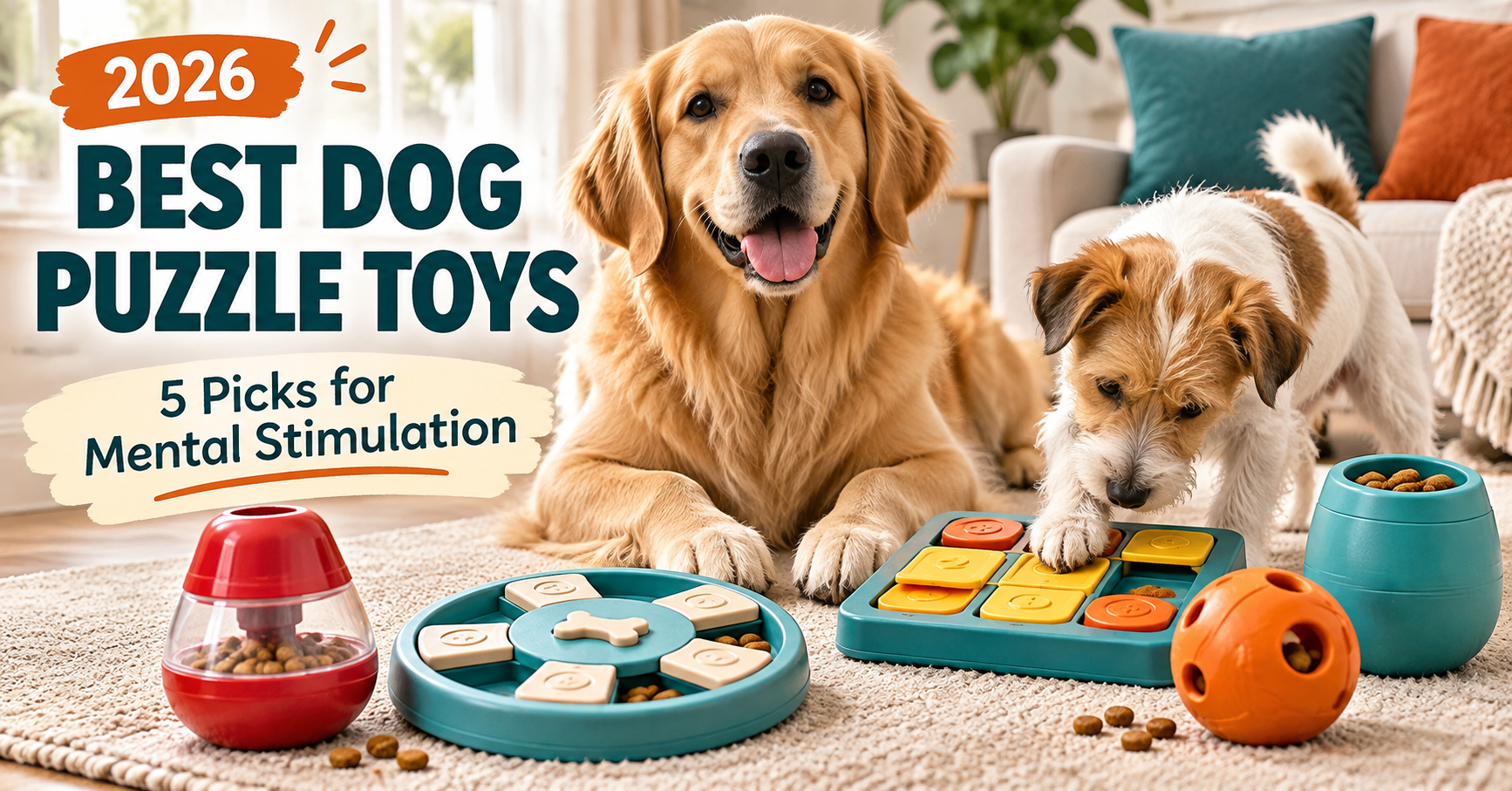
For 2026, we compared five enrichment options from four brands: Nina Ottosson Dog Smart, Nina Ottosson Dog Brick, KONG Wobbler, West Paw Toppl and Starmark Bob-A-Lot. Our selections emphasize different play patterns, suitable uses, cleaning needs and limitations rather than pretending every dog needs the same toy.
Best dog puzzle toys: quick comparison
| Toy | Best for | How it works | Key consideration |
|---|---|---|---|
| Nina Ottosson Dog Smart | Beginners | Lift removable bone-shaped covers to uncover treats | Supervise removable pieces |
| Nina Ottosson Dog Brick | Intermediate puzzle solvers | Slide, flip and lift obstacles | Multiple removable parts |
| KONG Wobbler | Dry-food dispensing | Tip and nudge a weighted wobbling dispenser | Not a chew toy |
| West Paw Toppl | Stuffed and frozen enrichment | Fill an open cup; optional two-size interlocking puzzle | Select size and filling carefully |
| Starmark Bob-A-Lot | Adjustable kibble challenge | Rock a weighted dispenser with adjustable openings | Use an appropriate kibble size |
Quick verdict: Begin with Dog Smart if your dog has never used a puzzle board. Choose Dog Brick for a more involved stationary puzzle, KONG Wobbler for a moving kibble toy, West Paw Toppl for creative wet-food or frozen filling, or Bob-A-Lot when adjustable dry-food dispensing is the priority.
How we selected these puzzle toys
We reviewed official manufacturer information for how each toy dispenses food, published difficulty levels, size options, care instructions, and safety limitations. We also considered whether the design is easier to introduce to a novice dog or better suited to a dog already comfortable with enrichment games.
We have not measured how long each toy keeps dogs occupied, compared durability in laboratory tests or personally tested these specific products. Difficulty varies considerably by dog, prior experience and food motivation. This is a research-based buying guide, not a claim of hands-on testing or veterinary outcomes.
1. Nina Ottosson Dog Smart — Best for beginners
The Dog Smart is an introductory puzzle built around covered food compartments. The plastic Dog Smart version uses removable, bone-shaped pieces that a dog lifts or nudges to find hidden rewards. Outward Hound identifies it as a Level 1 game, so its relatively straightforward action makes it a reasonable first lesson in treat puzzles.
What we like
- Easy to demonstrate one reward at a time.
- Helps owners observe whether a dog prefers sniffing, pawing or lifting.
- Difficulty can be adjusted modestly through how covers are positioned.
- Does not require a paid app or electronics.
Limitations
- Removable pieces require close supervision and careful storage.
- Experienced puzzle dogs may solve the board quickly.
- Not designed to be chewed or left in a crate unattended.
Best fit: a food-motivated dog trying its first supervised puzzle. Start with easy-to-find treats and celebrate small successes rather than making every compartment difficult immediately.
Check Price on Amazon(paid link)
View official Dog Smart product information
2. Nina Ottosson Dog Brick — Best intermediate puzzle
Dog Brick moves beyond single-step covers. Outward Hound lists it as a Level 2 puzzle with sliding sections, flip lids and removable bone-shaped covers. That gives owners several ways to hide rewards and gives the dog more than one type of action to learn.
What we like
- Several puzzle mechanisms in a single board.
- Can be introduced gradually by making some compartments easy.
- Suitable as a next step after a simple lift-and-find puzzle.
- Uses a portion of kibble or small treats during supervised play.
Limitations
- More pieces to wash and keep track of.
- Removing covers can frustrate dogs that have not learned the basic actions.
- Owners must prevent chewing of detachable parts.
Best fit: dogs that have already learned a beginner puzzle and are ready for sliding and flipping challenges. Give demonstrations and reduce difficulty if the dog becomes frustrated.
Check Price on Amazon(paid link)
View official Dog Brick product information
3. KONG Wobbler — Best for treat dispensing during meals
The KONG Wobbler is a weighted, upright food dispenser that tilts and spins when pushed. Dry treats or kibble exit as the dog learns to nudge it. Unlike a stationary board, the activity involves moving the toy across an appropriate floor area. KONG offers small and large versions and states that the toy unscrews for filling and cleaning.
What we like
- Transforms some dry-food feeding into interactive play.
- Movement creates a different challenge from sliding puzzle pieces.
- Easy-to-understand fill-and-wobble concept.
- Manufacturer says it is top-rack dishwasher safe.
Limitations
- KONG specifically warns that the Wobbler is not a chew toy.
- May be noisy on hard floors or awkward in small spaces.
- Not the best option for wet food.
- Food release depends partly on kibble dimensions.
Best fit: dogs that enjoy nudging moving objects and owners who want to offer part of a measured dry-food meal through a toy. Match the Wobbler’s size to the dog and supervise play.
Check Price on Amazon(paid link)
View official KONG Wobbler information
4. West Paw Toppl — Best for stuffed and frozen enrichment
West Paw Toppl takes a different approach. Its wide opening can hold suitable wet food, soft treats or part of a dog’s usual meal. Owners can also freeze a dog-safe filling to vary the experience. West Paw says compatible sizes can interlock for a more challenging treat-dispensing activity. The manufacturer currently lists Small, Large and XL sizes and top-rack dishwasher-safe care.
What we like
- Versatile for soft fillings as well as kibble-based activities.
- Wide opening can make filling and washing easier than narrow-cavity toys.
- Different sizes help owners choose an appropriate fit.
- Can serve as a slower, supervised feeding activity.
Limitations
- Rich fillings can add unintended calories.
- Frozen food may be inappropriate for dogs with certain dental or feeding sensitivities.
- Not an indestructible chew toy; damage requires replacement.
- Interlocking requires purchasing compatible sizes separately.
Best fit: owners interested in rotating different safe filling textures rather than relying on only loose kibble. The open-cup design is particularly useful for dogs new to licking-based enrichment.
Check Price on Amazon(paid link)
View official West Paw Toppl information
5. Starmark Bob-A-Lot — Best adjustable kibble challenge
The Starmark Bob-A-Lot is a weighted dispenser that wobbles as a dog paws or nudges it. Its adjustable openings regulate how readily dry food or treats come out, and the product is sold in different sizes. That adjustability offers a practical way to begin with a generous opening and make the task harder after a dog understands the activity.
What we like
- Adjustable food-release opening.
- Weighted wobbling motion creates an active challenge.
- Can be used with suitable dry kibble or treats.
- Multiple sizes for different dogs and feeding needs.
Limitations
- The moving weighted base may be cumbersome in tight rooms.
- Not suitable for every kibble shape or wet-food texture.
- Cleaning around openings may take more attention than cleaning an open bowl.
- Requires supervision; do not allow the dog to chew the dispenser.
Best fit: a dog that already understands rolling or nudging food dispensers and whose owner wants to adjust how frequently treats emerge.
Check Price on Amazon(paid link)
View Starmark’s official product catalog
Which dog puzzle toy should you buy?
| If your dog… | Start with… | Why |
|---|---|---|
| Has never solved a puzzle | Dog Smart | Simple lift-and-find pattern |
| Already solves basic puzzles | Dog Brick | Several types of obstacles |
| Enjoys pushing toys around | KONG Wobbler | Weighted, moving dry-food dispenser |
| Prefers licking or wet-food treats | West Paw Toppl | Wide opening for suitable fillings |
| Needs adjustable kibble release | Starmark Bob-A-Lot | Variable food-release challenge |
Choose by size, behavior and feeding needs before choosing by difficulty rating. Avoid giving a toy with small removable parts to a dog likely to swallow or chew them.
How to introduce a dog puzzle toy without frustration
- Start with familiar food. Use a measured portion of the dog’s usual kibble or veterinarian-approved treats.
- Demonstrate the first move. Lift a cover, slide a panel or nudge a dispenser to show where the food comes out.
- Make early rewards easy. An initial successful attempt can be more useful than immediately maximizing difficulty.
- Watch the dog’s body language. If the dog walks away, becomes overly excited or starts chewing components, stop and simplify.
- Keep sessions supervised and manageable. End the game while the dog is still comfortable, then clean and store the toy.
Puzzle toy safety: what owners should know
- Supervise every session, especially with removable puzzle components or new toys.
- Choose a suitable toy size. Follow the manufacturer’s recommendations and account for how your dog plays, not just body weight.
- Check for damage. Remove any cracked, shredded or loose toy immediately.
- Do not confuse food puzzles with chew toys. Several of these products are designed for supervised food work, not sustained chewing.
- Count the food. Deduct puzzle kibble and treats from the dog’s daily calorie allowance.
- Clean thoroughly. Follow each manufacturer’s instructions and do not leave wet fillings sitting out.
- Consider medical needs. Dogs with dental pain, swallowing difficulties or special diets may need advice from a veterinarian before using challenging feeders.
Puzzle toys vs. snuffle mats vs. slow feeders
A puzzle board asks a dog to perform actions such as lifting or sliding. A food-dispensing toy rewards nudging, rolling or wobbling. A snuffle mat emphasizes sniffing among fabric strips, while a slow-feeder bowl primarily changes how food is accessed. None is automatically better for every dog. Rotating safe activities may help prevent a single routine from becoming stale.
For dogs needing more daily activity, see our guide to exercise needs by age and size. For a different type of mealtime tool, explore our automatic dog feeder comparison. These products solve different problems and are not interchangeable.
Frequently asked questions
Are puzzle toys good for puppies?
Some puppies can enjoy simple, supervised food puzzles when the toy is suitable for their age, size and chewing habits. Choose an easy design, supervise every moment and put the toy away afterward.
How difficult should a dog puzzle be?
Start at a level your dog can succeed with after a little guidance. If your dog repeatedly chews, paws frantically or gives up, the task may be too difficult or inappropriate for that dog.
Can a puzzle toy replace a walk?
No. Puzzle toys add enrichment but do not replace physical exercise, appropriate outdoor activity, social interaction or veterinary care.
Can I use my dog’s regular kibble?
Often yes, if the dispenser is designed for dry food and the kibble fits the openings. Measure the portion and follow the toy’s care instructions. Soft-food options such as Toppl can support other dog-safe fillings.
Can a dog use a puzzle toy alone?
For these selections, supervised use is the safest starting point. Manufacturers caution against unsupervised use of puzzle toys and advise removing damaged products.
How often should I rotate puzzle toys?
There is no required schedule. Rotating a few safe toys and changing the difficulty gradually can keep the activity varied, provided your dog remains comfortable with each design.
Final verdict
For a first puzzle, Nina Ottosson Dog Smart offers a straightforward introduction. Dog Brick adds varied mechanisms, KONG Wobbler creates a moving kibble challenge, West Paw Toppl offers filling versatility, and Starmark Bob-A-Lot brings adjustable dry-food dispensing.
Whichever you choose, the goal is not to make feeding as difficult as possible. The best enrichment experience is one your dog can enjoy safely with appropriate supervision and rewards.
Manufacturer sources and editorial notes
Prepared in November 2026 from public manufacturer descriptions and safety instructions. Product designs, materials, availability and care guidance may change. Confirm current information before buying.
- Outward Hound — Dog Smart
- Outward Hound — Dog Brick
- KONG — Wobbler
- West Paw — Toppl
- Starmark — Treat Dispensing Bob-A-Lot product listing
Editorial note: Product roles above are research-based recommendations, not claims of first-hand testing. Affiliate links are provided for shopping convenience; product availability and prices may change.