Affiliate disclosure: Fit For Your Dog may earn a commission from qualifying purchases made through certain links on this page, at no additional cost to you.
Editorial note: This guide explains how to read a dog food label using current information from AAFCO, FDA, and veterinary nutrition resources.
It is educational rather than a recommendation for one specific brand or diet.
Read more about our process on How We Review.
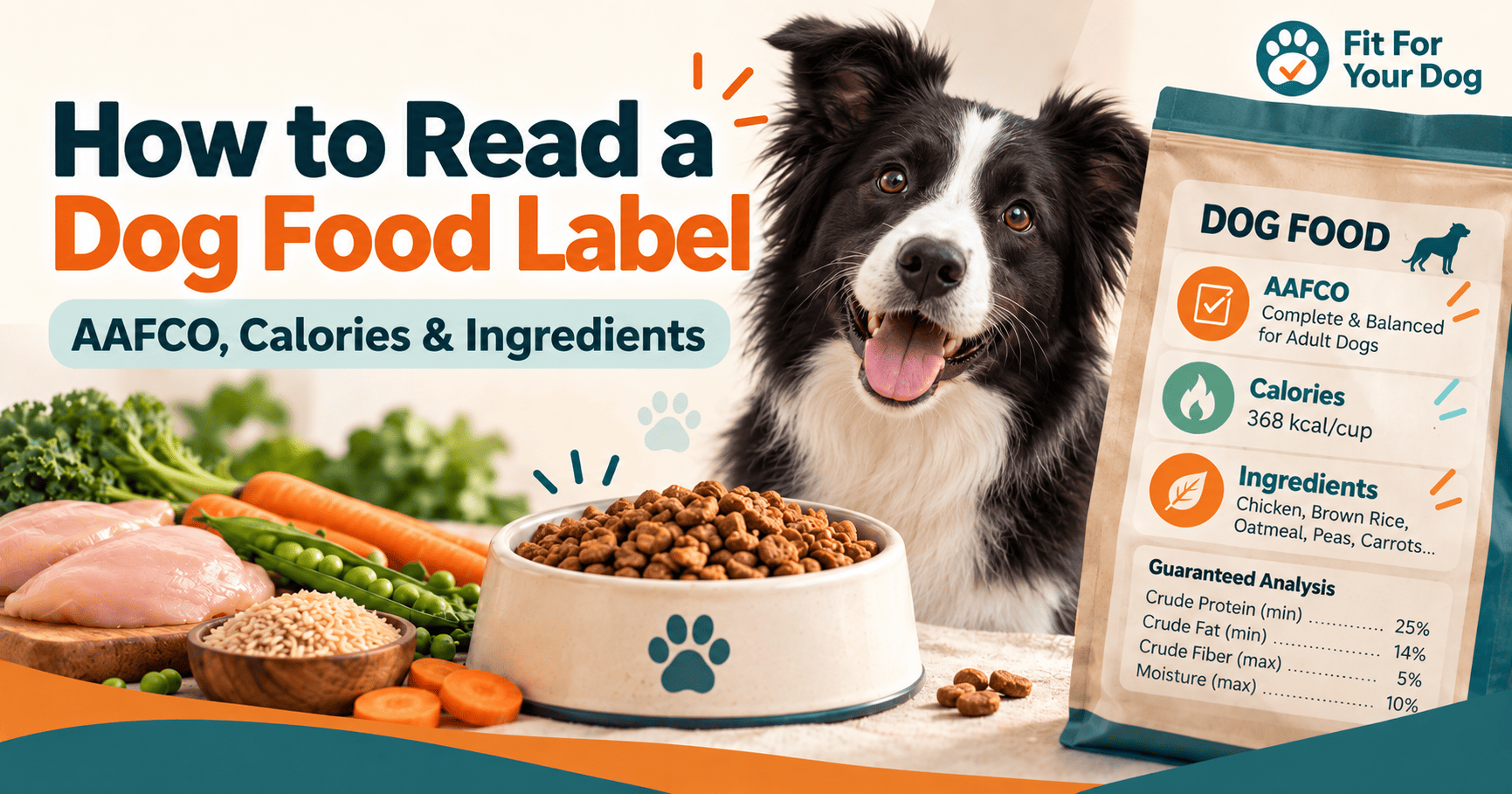
Dog food labels can look simple from the front of the bag and surprisingly complicated once you turn the package around. You may see terms such as complete and balanced, adult maintenance, all life stages, crude protein, kcal/kg, natural, premium, grain-free, with chicken, and a long ingredient list that seems to require a chemistry degree.
The good news is that you do not need to decode every word on the package. If you know where to look, a dog food label can answer several practical questions: Is this food intended to be a complete diet? What life stage is it for? How many calories does it provide? What nutrients are guaranteed? How should it be fed? Who makes or distributes it?
This guide walks through the label in the order that is most useful for a dog owner—not necessarily the order that marketing puts it on the package.
Dog food label checklist: what to read first
Check whether the food is complete and balanced and which life stage it is designed for.
Look for kcal per cup, can, pouch, or other familiar serving unit—not just the size of the feeding scoop.
Understand the minimum protein and fat and maximum fiber and moisture listed on the package.
Ingredients are listed by weight, but the list alone does not tell you the overall nutritional quality of the finished food.
Use them as a starting point, then adjust for your dog’s body condition, activity, age, and veterinary guidance.
What information is normally required on a dog food label?
AAFCO’s model pet-food regulations describe several core pieces of information that appear on pet-food labels, while FDA has federal labeling requirements for animal food and individual states may also apply their own rules.
| Label section | What it tells you | Why it matters |
|---|---|---|
| Product / brand name | Identifies the food | Product-name wording may also be subject to labeling rules. |
| Species | Whether the product is intended for dogs, cats, or another animal | Dogs and cats do not have identical nutrient requirements. |
| Net quantity | How much food is in the package | Useful when comparing cost and package size. |
| Guaranteed analysis | Guaranteed levels of selected nutrients | Helps you understand the nutrient figures the manufacturer guarantees. |
| Ingredient statement | Ingredients in descending order by weight | Shows what ingredients are used, but not their digestibility or overall diet quality. |
| Nutritional adequacy statement | Whether the food is complete and balanced and for which life stage | One of the most useful parts of the package. |
| Feeding directions | Suggested amount to feed | Provides a starting point for daily portions. |
| Manufacturer / distributor information | Who is responsible for the product | Gives you a company to contact for additional nutrition information. |
Start with the AAFCO nutritional adequacy statement
If you read only one small-print section on a dog food package, make it the nutritional adequacy statement. AAFCO describes this as a key part of matching a food to an animal’s nutritional needs.
A complete diet may use wording similar to:
Formulated to meet: the food is formulated to meet the nutritional levels established by an AAFCO Dog Food Nutrient Profile for a stated life stage.
Animal feeding tests: feeding tests using AAFCO procedures substantiate that the food provides complete and balanced nutrition for a stated life stage.
Intermittent or supplemental feeding only: the product is not represented as a complete and balanced everyday diet for normal continuous feeding.
Do not confuse an AAFCO statement with an AAFCO endorsement. AAFCO does not approve, certify, test, or endorse individual pet foods. AAFCO develops model regulations, nutrient profiles, ingredient definitions, and feeding-test protocols that are used within the U.S. regulatory system.
What does “complete and balanced” mean?
In AAFCO terminology, complete means the food contains the required nutrients, while balanced means those nutrients are present in appropriate proportions for the stated use.
That is different from a treat, topper, supplement, chew, or food labeled for intermittent or supplemental feeding. A product can be perfectly appropriate for its intended purpose without being designed to provide an entire diet by itself.
Understand the life-stage wording
AAFCO label guidance recognizes life-stage categories that include growth, gestation/lactation, maintenance, and all life stages. These categories matter because puppies, reproducing dogs, and adult dogs do not have identical nutritional needs.
Adult maintenance
A food labeled for adult maintenance is intended for healthy adult dogs rather than growth or reproduction.
Growth
A growth statement is intended for puppies. For dog foods making a growth or all-life-stages claim, the label may also specify whether the food is appropriate for the growth of large-size dogs expected to weigh 70 lb or more as adults.
That line deserves attention when you are feeding a large- or giant-breed puppy because the statement can say either that large-size growth is included or excluded.
All life stages
“All life stages” does not mean “specially optimized for every individual dog.” WSAVA notes that foods labeled for all life stages are formulated to meet the nutrient requirements associated with reproduction and growth. Whether such a food is the best practical choice for a particular adult or senior dog is a separate question that can depend on calories, body condition, medical needs, and veterinary advice.
How to read the guaranteed analysis
The guaranteed analysis usually appears near the ingredient list. At minimum, dog food labels generally include:
- crude protein — minimum;
- crude fat — minimum;
- crude fiber — maximum;
- moisture — maximum.
The word crude refers to the analytical method used to estimate these nutrient categories. It does not mean the ingredient is dirty, low quality, or unrefined.
Additional nutrient guarantees may appear voluntarily or may be required when the package makes certain nutrient-related claims.
Why you should not compare wet and dry food percentages directly
This is one of the most common label-reading mistakes. Guaranteed-analysis values are generally shown on an as-fed basis, meaning the food’s water is still included in the percentage.
A canned food may contain roughly 75% or more moisture, while a kibble may contain around 10% moisture. Because water dilutes the as-fed percentages, a canned food can show a lower protein percentage on the package even when its protein concentration is similar or higher once moisture is removed from the comparison.
For a more meaningful wet-vs-dry nutrient comparison, convert both foods to a dry-matter basis.
Simple formula:
Dry matter % = 100 − moisture %
Dry-matter nutrient % = as-fed nutrient % ÷ dry matter % × 100
Hypothetical example: if a canned dog food lists 10% crude protein and 75% moisture, it contains 25% dry matter. On a dry-matter basis, the protein would be approximately 40%: 10 ÷ 25 × 100.
This calculation is useful for rough comparisons, but remember that guaranteed-analysis figures are minimums and maximums rather than a full typical nutrient profile.
How to read the ingredient list
FDA and AAFCO require pet-food ingredients to be listed in descending order by weight. The ingredient that contributes the greatest weight when the food is formulated appears first.
That sounds simple, but ingredient lists can be misleading when used as a shortcut for judging the entire food.
Fresh ingredients contain water
A fresh meat ingredient can appear high on the list partly because it contains substantial moisture before processing. A drier ingredient contributes less water weight. This makes simple “first ingredient wins” comparisons less useful than they appear.
The list does not show digestibility or bioavailability
WSAVA specifically cautions that an ingredient name does not tell you its nutritional quality, digestibility, or how available its nutrients are to the dog. The finished diet and the manufacturer’s formulation, testing, quality control, and nutrition expertise matter too.
“Chemical-sounding” does not automatically mean unsafe
Vitamins, minerals, amino acids, preservatives, and other functional ingredients may have unfamiliar names. Familiar-sounding ingredients are not automatically more nutritious, and unfamiliar names are not automatically harmful.
Calories: one of the most practical numbers on the bag
AAFCO label guidance calls for calorie content to be expressed as kilocalories per kilogram (kcal/kg) and also in a familiar unit such as kcal per cup, can, biscuit, or similar serving unit.
For day-to-day feeding, the familiar-unit number is usually the easiest to use.
| Food A | Food B | Why it matters |
|---|---|---|
| 320 kcal/cup | 450 kcal/cup | The same physical cup of Food B delivers about 41% more calories. |
This is why measuring only by “cups per day” can be misleading when switching foods. If you move from a lower-calorie food to a more calorie-dense food and keep feeding the same number of cups, your dog’s calorie intake can rise substantially.
Feeding directions are a starting point, not a prescription
Complete and balanced pet foods generally include feeding directions. These usually provide an amount of food based on the dog’s body weight and sometimes life stage.
AAFCO notes that feeding directions are guidelines and may need to be modified for an individual animal. Two dogs that weigh the same can need different amounts because of differences in age, activity, neuter status, environment, body condition, metabolism, and health.
Watch your dog’s weight and body condition over time. If your dog is consistently gaining or losing weight, the amount being fed may need to change. Your veterinarian can help determine an appropriate calorie target when the situation is more complex.
Do not let marketing words outrank the nutrition information
The front of the bag is designed to sell the product. The back and side panels usually contain the information that helps you evaluate it.
Words such as premium, holistic, gourmet, ancestral, wholesome, superfood, or similarly appealing phrases may sound meaningful but do not necessarily tell you whether the diet is nutritionally appropriate for your individual dog.
WSAVA’s pet-food selection guidance advises owners to focus on nutritional adequacy, calories, manufacturer information, formulation expertise, quality-control practices, and the ability of the company to answer nutrition questions rather than relying on marketing language alone.
What about “natural,” “organic,” “human grade,” and “grain-free”?
These terms can have specific regulatory or marketing meanings, but none should replace the basic label checks above.
- Natural: a labeling term with defined limitations under AAFCO model rules; it is not the same as “complete and balanced.”
- Organic: relates to production and certification standards, not whether the food is nutritionally appropriate for every dog.
- Human grade: relates to ingredient and handling requirements associated with the claim; it does not by itself prove superior nutrition for a dog.
- Grain-free: describes an ingredient characteristic. It does not tell you whether the food is complete, appropriately formulated, or right for your dog.
Manufacturer information matters too
A label should identify the company responsible for the food. WSAVA recommends going beyond the package when necessary and asking the manufacturer useful questions such as:
- Who formulates the diet?
- Does the company employ appropriately qualified nutrition professionals?
- What quality-control procedures are used for ingredients and finished foods?
- Can the company provide a typical nutrient analysis beyond the minimum guarantees on the label?
- Does the company conduct or support nutrition research?
- Where is the food manufactured?
If a company cannot provide basic nutrition or manufacturing information when asked, that is useful information for your decision.
A sample dog food label walkthrough
Imagine a hypothetical bag with the following information:
| Nutritional adequacy | Complete and balanced for adult maintenance |
|---|---|
| Crude protein | 26% minimum |
| Crude fat | 15% minimum |
| Crude fiber | 4% maximum |
| Moisture | 10% maximum |
| Calories | 380 kcal/cup |
| Feeding guide | 2 cups/day for a hypothetical weight range |
Here is how to interpret it:
- Adult maintenance: this hypothetical food is being represented as a complete everyday diet for adult dogs, not puppy growth.
- 26% protein: this is a guaranteed minimum on an as-fed basis, not an exact average amount in every batch.
- 10% moisture: the food is relatively dry, so direct comparison with canned food percentages would require a moisture adjustment.
- 380 kcal/cup: two cups would provide approximately 760 kcal before treats, toppers, or other foods are added.
- Feeding directions: the suggested two cups are a starting estimate rather than a personalized prescription.
Five common dog food label mistakes
Mistake 1: Looking only at the first ingredient.
Ingredient order by weight does not summarize the nutritional quality of the finished diet.
Mistake 2: Assuming “AAFCO approved.”
AAFCO does not approve individual pet foods. Read the nutritional adequacy statement instead.
Mistake 3: Comparing wet and dry protein percentages directly.
Moisture can make the label percentages look dramatically different.
Mistake 4: Ignoring calories.
Two foods fed in the same cup amount can deliver very different calorie totals.
Mistake 5: Treating feeding directions as exact.
Your dog’s real needs may be higher or lower than the package estimate.
Quick label-reading routine at the store
- Confirm the food is intended for dogs.
- Find the nutritional adequacy statement.
- Confirm the life stage matches your dog.
- If feeding a large-breed puppy, check the large-size growth wording.
- Find kcal per cup/can/pouch.
- Review the guaranteed analysis.
- Read the ingredient list for ingredients you specifically need to include or avoid, but do not use it as the sole quality test.
- Review the feeding directions.
- Identify the manufacturer or distributor and contact information.
- For medical conditions, unusual growth needs, food allergies, or therapeutic diets, discuss the choice with your veterinarian.
Frequently asked questions
Does AAFCO approve dog food?
No. AAFCO states that it does not approve, certify, test, or endorse individual pet foods. It develops model regulations, nutrient standards, ingredient definitions, and feeding protocols used within the regulatory system.
What is the most important line on a dog food label?
The nutritional adequacy statement is one of the most useful because it tells you whether a food is represented as complete and balanced and identifies the life stage for which it is intended.
Does the first ingredient tell me whether a dog food is good?
No. Ingredients are listed by weight, but the list does not reveal ingredient digestibility, nutrient bioavailability, quality-control practices, or whether the finished diet meets your individual dog’s needs.
What does crude protein mean?
“Crude” refers to the analytical method used to estimate protein. It does not mean the protein is raw, dirty, or low quality.
How do I compare canned food and kibble protein?
Because the moisture levels are very different, use a dry-matter comparison rather than comparing the as-fed percentages directly. Subtract moisture from 100 to find the dry-matter percentage, then divide the as-fed nutrient percentage by the dry-matter percentage and multiply by 100.
Is “all life stages” better than adult maintenance?
Not automatically. They describe different nutritional adequacy claims. All-life-stages foods are formulated to meet requirements associated with growth and reproduction, while adult-maintenance foods are intended for adult maintenance. The better fit depends on the individual dog.
How many calories should my dog eat?
There is no single calorie number based only on breed or body weight. Age, body condition, activity, neuter status, environment, health, and other factors affect energy needs. Use the label as a starting point and ask your veterinarian for an individualized target when needed.
Final takeaway
You do not need to memorize every ingredient or marketing term to read a dog food label well.
Start with the nutritional adequacy statement, confirm the correct life stage, check calories, understand the guaranteed analysis, and then read the ingredient list in context rather than treating it as a complete quality score.
The strongest label-reading habit is to separate regulatory nutrition information from front-of-package marketing—and to use your dog’s body condition, health, and veterinary guidance to decide whether the food is actually working for your individual dog.
Related Food & Nutrition guides
- Best Fresh Dog Food Subscriptions (2026)
- The Farmer’s Dog vs Ollie (2026)
- Dog Food & Nutrition Guides
- How We Review
Sources & update notes
This guide was researched and updated for September 2026. U.S. pet-food rules can involve both federal requirements and state regulations, and labeling models can change over time.
Veterinary note: This article provides general educational information and is not veterinary advice.
Dogs with medical conditions, abnormal growth, significant weight change, suspected food reactions, or therapeutic diet needs should receive individualized guidance from a veterinarian.