Affiliate disclosure: Fit For Your Dog may earn a commission from qualifying purchases made through certain links on this page, at no additional cost to you.
Affiliate disclosure: This post contains affiliate links. If you buy through an eligible link, Fit For Your Dog may earn a commission at no extra cost to you. As an Amazon Associate I earn from qualifying purchases. See our Affiliate Disclosure.
Editorial note: This comparison is research-based. We reviewed current manufacturer specifications, feeding controls, capacity, power backup, kibble compatibility, cleaning features, and app functions. We did not conduct simultaneous long-term portion-accuracy or jam testing. Read more about our process on How We Review.
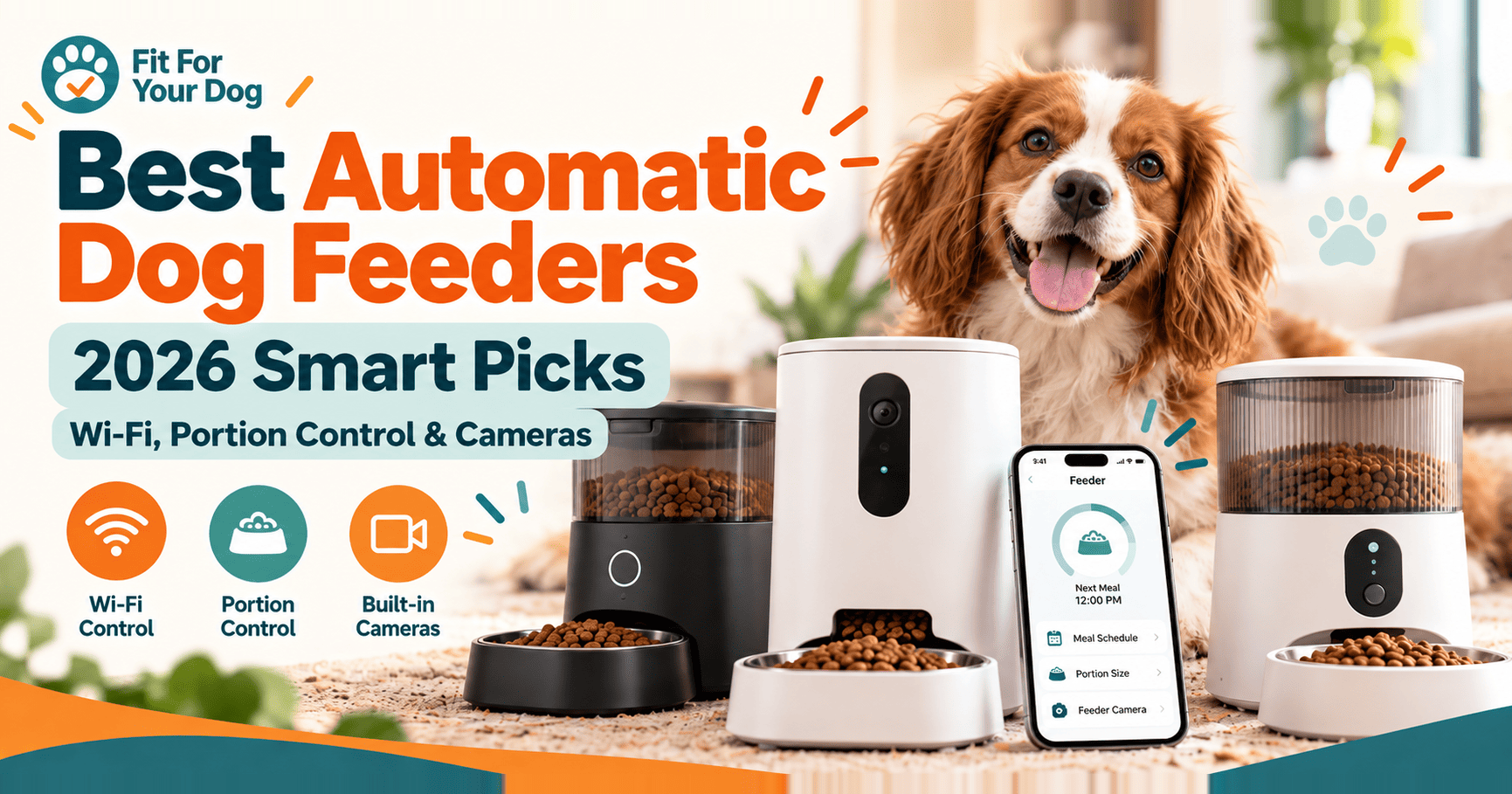
An automatic dog feeder can make scheduled meals easier, especially when your workday changes, your dog needs smaller meals spread through the day, or you want a backup plan for early mornings and short periods away from home.
But not every automatic feeder is equally useful for dogs. Hopper size, portion range, kibble diameter, bowl design, backup power, Wi-Fi reliability, and how much food a feeder can dispense in one meal all matter more than a long list of app features.
For 2026, we compared five current feeders from PetSafe, PETLIBRO, WOPET, and PETKIT. Most are best suited to small and medium dogs eating dry kibble. Owners of very large dogs, dogs on wet-food diets, or dogs with medical feeding requirements may need a different setup.
Best automatic dog feeders: quick picks
Automatic dog feeder comparison
| Feeder | Capacity | Meals | Connectivity | Backup power | Best fit |
|---|---|---|---|---|---|
| PetSafe Smart Feed | 24 cups | Up to 12/day | Wi-Fi + app | 4 D-cell backup batteries; programmed meals continue if Wi-Fi is lost | Best overall for small/medium dogs |
| PETLIBRO Granary WiFi 5L | 5L | 1-10/day | 2.4 & 5GHz Wi-Fi | 3 D batteries for emergency scheduled feeding | Value + flexible portions |
| WOPET Patrol F07 Pro | 6L | Up to 15/day | Wi-Fi + app | Verify current backup behavior for exact version | Frequent small meals |
| PETKIT Fresh Element Solo | 12 cups / 3L | App-scheduled | 2.4GHz Wi-Fi | 5 AAA batteries; scheduled feeding continues | Compact setup / small dogs |
| WOPET Heritage View | 6L | Model-dependent; dual-bowl version up to 10/day | 2.4 & 5GHz Wi-Fi on current dual-bowl model | 3 D batteries on current hardware | Camera monitoring / multi-pet homes |
How we chose these automatic dog feeders
We focused on features that affect day-to-day feeding rather than treating every smart feature as equally important.
- Portion flexibility: Can the feeder handle both small snacks and realistic dog-sized meals?
- Meal scheduling: How many feeding events can be programmed in a day?
- Food capacity: Is the hopper large enough to reduce constant refilling?
- Kibble compatibility: Does the manufacturer publish a maximum kibble size or food-type limitation?
- Power protection: Will scheduled feeding continue during an internet or power interruption?
- App usefulness: Does the app provide feeding controls and useful alerts?
- Cleaning: Are food-contact parts removable or dishwasher safe?
- Dog fit: Is the feeder realistically sized for dogs rather than marketed mainly around cats?
1. PetSafe Smart Feed — Best overall
The PetSafe Smart Feed stands out because its feeding range is unusually practical for dogs. The current model holds 24 cups of dry or semi-moist food and can schedule up to 12 meals per day.
Each meal can be set from 1/8 cup to 4 cups. That wide range makes it more flexible than many cat-first automatic feeders that dispense only small gram-based portions.
PetSafe also includes a Slow Feed setting that can dispense meals larger than 1/8 cup gradually over about 15 minutes. This can help spread out a meal for fast eaters, although a feeder should not be treated as a medical solution for swallowing problems, vomiting, or suspected bloat risk.
The My PetSafe app can schedule and adjust meals remotely and send alerts when food is low or the hopper is empty. PetSafe states that programmed meals continue on schedule if the Wi-Fi connection is lost or the feeder goes offline. The current model also supports four D batteries (not included) as backup power.
For cleaning, the lid, hopper, bowl, and bowl holder are listed as top-rack dishwasher safe. PetSafe specifically describes the feeder as best suited to cats and small or medium dogs.
Pros
- Large 24-cup hopper
- Up to 12 meals daily
- 1/8-cup to 4-cup meal range
- Slow Feed mode
- Low-food and empty-hopper alerts
- Dry and semi-moist food compatibility
- Dishwasher-safe removable parts
Cons
- Larger footprint than compact 3L feeders
- Primarily intended for small/medium dogs rather than giant breeds
- Smart controls add cost compared with simple timer feeders
Check Price on Amazon(paid link) View manufacturer specs
2. PETLIBRO Granary WiFi 5L — Best value smart feeder
The PETLIBRO Granary WiFi uses a 5-liter hopper and supports both 2.4GHz and 5GHz Wi-Fi. Current manufacturer specifications list 1-10 scheduled meals and 1-50 portions per meal.
Each portion is approximately 20 ml, which PETLIBRO describes as roughly 10 g or around 1/12 cup depending on the food. Because kibble density varies, the most accurate way to set a daily amount is to dispense a test meal and weigh it on a kitchen scale before relying on the app’s portion count.
The Granary is for dry food only. PETLIBRO lists a compatible kibble diameter of approximately 2-15 mm. The company says the feeder is better suited to small or medium pets than large dogs.
Its backup system uses three alkaline D batteries. During battery-only operation, some smart functions such as Wi-Fi are disabled to conserve power, but preset meal schedules continue.
Pros
- 5L capacity
- 2.4GHz and 5GHz Wi-Fi
- 1-10 scheduled meals
- Up to 50 portions per meal
- Battery backup for preset schedules
- App alerts for low food and feeder issues
- Removable bowl
Cons
- Dry food only
- Not designed around large-breed meal sizes
- Portion volume is approximate and varies with kibble density
- Smart functions are reduced during battery-only operation
Check Price on Amazon(paid link) View manufacturer specs
3. WOPET Patrol F07 Pro — Best for frequent small meals
The WOPET Patrol F07 Pro offers a 6L hopper and supports up to 15 meals per day, one of the highest meal-count limits among the feeders in this comparison.
WOPET currently lists a portion size of approximately 5 g per portion, with up to 50 portions per meal. As with every portion-based feeder, the real calorie output depends on the density and shape of your dog’s kibble.
The app provides feeding records and low-food alerts. The feeder also includes a short voice-message function and a twist-lock lid designed to make it harder for pets to open the hopper.
The Patrol is most appealing when the goal is not one or two large meals but several smaller scheduled feedings. Dogs with medical conditions requiring frequent meals should still have their schedule and calorie target set with veterinary guidance.
Pros
- 6L food capacity
- Up to 15 meals per day
- Up to 50 portions per meal
- Low-food alerts
- Feeding history in the app
- Locking lid
Cons
- Small portion increments require calibration with your dog’s actual kibble
- Less useful for dogs that need very large meals
- Verify backup-power behavior for the exact F07 Pro version before relying on it during outages
Check Price on Amazon(paid link) View manufacturer specs
4. PETKIT Fresh Element Solo — Best compact feeder
The PETKIT Fresh Element Solo has a 3L / 12-cup capacity and is specifically listed by PETKIT for cats and small-breed dogs.
It supports dry kibble up to approximately 0.47 inch / 12 mm and freeze-dried food up to approximately 0.35 inch / 9 mm. Each scheduled meal can dispense 1-5 portions, with PETKIT estimating a portion at around 10 g or 1/12 cup.
The feeder uses 2.4GHz Wi-Fi. If the internet connection drops, preset meal schedules can continue. With five AAA batteries installed, the Fresh Element Solo can also continue scheduled feeding during a power outage. PETKIT’s current feeder comparison lists up to about seven days of backup operation for this model.
The main limitation is size: this is a compact feeder, not a high-volume system for a large dog eating multiple cups at a time.
Pros
- Compact footprint
- 12-cup / 3L capacity
- Battery backup
- Preset meals continue offline
- Dry and appropriately sized freeze-dried kibble support
- App status notifications
- Stainless-steel food-contact material
Cons
- Best for small-breed dogs
- 2.4GHz Wi-Fi only
- Smaller hopper than 5L and 6L competitors
- Not designed for large per-meal portions
Check Price on Amazon(paid link) View manufacturer specs
5. WOPET Heritage View — Best automatic feeder with camera
WOPET’s Heritage View line combines automatic feeding with a 1080p camera. Current Heritage View documentation lists a 6L hopper, full-HD video, wide-angle viewing, infrared night vision, and battery backup using three D batteries.
The current dual-bowl Heritage View version supports 2.4GHz and 5GHz Wi-Fi, up to 10 scheduled meals per day, and 1-20 portions per meal. WOPET also sells or has sold single-bowl Heritage View variants, so check the exact model number before comparing meal limits or accessories.
A camera does not verify calorie intake on its own, but it can answer a practical question that ordinary smart feeders cannot: Did my dog actually come to the bowl?
For homes with more than one dog, a dual bowl does not automatically solve food stealing. If dogs guard food, require different diets, or routinely eat from each other’s bowls, feeding them separately is safer.
Pros
- 6L hopper
- 1080p camera
- Night vision
- App-controlled feeding
- Dual-bowl option
- Battery backup on current Heritage View hardware
Cons
- More expensive and complex than a feeder without a camera
- Different Heritage View versions have different scheduling limits
- A shared dual bowl does not prevent resource guarding or food stealing
- Camera features depend on power and network conditions
Check Price on Amazon(paid link) View manufacturer specs
How accurate are automatic feeder portions?
Automatic feeders usually control food by volume, motor rotations, or a manufacturer’s defined “portion.” That does not mean every portion contains the same number of calories.
Two kibbles can have different shapes, sizes, densities, and calorie content per cup. A portion that weighs 10 g with one food might weigh more or less with another.
Best setup method:
- Program a test meal.
- Dispense it into an empty bowl.
- Weigh the food on a kitchen scale.
- Compare the grams dispensed with your dog’s target daily amount.
- Repeat several times before trusting the schedule.
If you change kibble brands or formulas, repeat the test. Different kibble can flow differently through the same feeder.
Wi-Fi vs non-Wi-Fi automatic dog feeders
A non-Wi-Fi feeder can be the better choice if you only need a predictable timer. Fewer connected features mean fewer app accounts, fewer network issues, and usually a lower purchase price.
A Wi-Fi feeder becomes useful when you want to:
- change feeding times remotely;
- dispense an unscheduled meal from your phone;
- see feeding records;
- receive low-food or blockage alerts;
- check a camera-equipped model while away.
The most important smart-feeder feature is not remote control itself. It is whether the feeder stores the feeding schedule locally so meals can continue when the internet goes down.
Which automatic feeder is best for small vs large dogs?
Small dogs are easier to match with consumer automatic feeders because their meal volumes are typically lower. PETKIT Fresh Element Solo is explicitly designed for small-breed dogs, while PETLIBRO Granary and PetSafe Smart Feed are positioned around small to medium pets.
For medium dogs, the PetSafe Smart Feed is especially flexible because it can dispense up to 4 cups in one scheduled meal.
For a large or giant dog, do not assume that a 5L or 6L hopper automatically means the feeder is appropriate. Check maximum food per meal, bowl size, kibble diameter limits, hopper runtime for your dog’s intake, and whether the dog can tip or break into the unit.
What happens during a power outage?
Backup power is one of the most important specifications to check before buying an automatic feeder.
Current PETLIBRO Granary models support emergency operation with three D batteries; scheduled meals continue while Wi-Fi functions are disabled. PETKIT Fresh Element Solo can use five AAA batteries and continue its programmed feeding schedule. Current WOPET Heritage View hardware also lists D-battery backup.
Internet loss and electrical power loss are different problems. Some feeders can continue a local schedule when Wi-Fi is unavailable but still require wall power. Always verify both behaviors for the exact model you own.
What kind of kibble works in an automatic feeder?
Most hopper-style automatic feeders are designed primarily for dry kibble. PETLIBRO lists approximately 2-15 mm kibble for the Granary. PETKIT lists dry kibble up to about 12 mm and smaller freeze-dried pieces for the Fresh Element Solo.
Large, irregular, sticky, oily, or unusually soft pieces can increase the chance of bridging or jamming. Do not assume a feeder can handle every “dry” dog food.
PetSafe is unusual in this group because it also describes the Smart Feed as compatible with many dry and semi-moist foods through its conveyor-style dispensing system.
Can an automatic feeder dispense wet dog food?
Not these hopper-style models. PETLIBRO specifically states that the Granary is for dry food, and the other feeders in this comparison are primarily designed around dry or compatible semi-moist food.
Wet-food feeders need a different design with sealed compartments and, in some products, active or passive cooling. If your dog eats canned, fresh, raw, or refrigerated food, choose a feeder specifically engineered for that food type.
Cleaning matters more than most smart features
Food oils and crumbs accumulate around the bowl, chute, rotor, hopper, and lid. A feeder that is difficult to disassemble can become unpleasant to maintain.
Before buying, check whether the bowl and food-contact parts can be removed. PetSafe lists the Smart Feed lid, hopper, bowl, and bowl holder as top-rack dishwasher safe. Other models use removable bowls and hopper components that should be cleaned according to the manufacturer’s instructions.
Who should avoid relying on an automatic dog feeder?
An automatic feeder can support a routine, but it should not replace appropriate supervision.
Use extra caution or ask your veterinarian before relying on one when a dog:
- has diabetes or another condition requiring tightly coordinated meals and medication;
- has recurring vomiting, regurgitation, swallowing problems, or suspected gastrointestinal disease;
- requires a prescription or refrigerated diet;
- has a history of severe food guarding;
- lives with another pet that steals food;
- can break into cabinets, bins, or food containers;
- needs close monitoring of appetite because of illness or recovery;
- is being left alone for a period longer than is appropriate simply because a feeder can dispense food.
Which automatic dog feeder should you choose?
Choose PetSafe Smart Feed if: you want the most dog-friendly portion range and a large 24-cup hopper.
Choose PETLIBRO Granary WiFi if: you want a strong balance of price, 5L capacity, dual-band Wi-Fi, and flexible portion scheduling.
Choose WOPET Patrol F07 Pro if: your priority is spreading food across many small scheduled meals.
Choose PETKIT Fresh Element Solo if: you have a small dog and want a compact feeder with backup batteries.
Choose WOPET Heritage View if: a camera is genuinely useful to you and you want visual confirmation around feeding time.
Frequently asked questions
Are automatic feeders good for dogs?
They can be useful for consistent scheduled meals, portioning, early breakfasts, and splitting food into multiple daily feedings. They are best used as a convenience tool rather than a replacement for supervision and routine care.
Can a dog automatic feeder work without Wi-Fi?
Many smart feeders store the feeding schedule locally and can continue scheduled meals when Wi-Fi is unavailable. Remote app controls and alerts may stop until the connection returns. Check the exact model’s offline behavior before purchase.
What is the best automatic feeder for a medium dog?
Among the feeders compared here, PetSafe Smart Feed has one of the most practical portion ranges for medium dogs because scheduled meals can range from 1/8 cup to 4 cups. Always confirm the bowl, hopper, and daily capacity against your individual dog’s diet.
Do automatic feeders measure food accurately?
They can dispense consistent mechanical portions, but the actual grams and calories vary with kibble size and density. Test several dispenses on a kitchen scale and recalibrate whenever you change foods.
Can I put wet dog food in an automatic feeder?
Only in a feeder specifically designed for wet or refrigerated food. Standard hopper feeders such as PETLIBRO Granary are designed for dry food and should not be filled with canned or fresh food.
Will an automatic feeder still work during a power outage?
Some models have battery backup. PETLIBRO Granary, PETKIT Fresh Element Solo, and current WOPET Heritage View hardware support backup batteries for scheduled feeding. Install and test batteries before you need them.
Can two dogs share one automatic feeder?
They can physically share some large or dual-bowl feeders, but sharing is not appropriate when dogs eat at different speeds, require different diets, guard food, or steal from each other. Separate feeding areas are often safer.
Final comparison
PetSafe Smart Feed is the strongest all-around fit in this group for dog owners because its 24-cup hopper and 1/8-to-4-cup meal range are unusually flexible.
PETLIBRO Granary WiFi offers a useful middle ground for small and medium dogs, while WOPET Patrol F07 Pro is built around frequent scheduled feeding. PETKIT Fresh Element Solo makes the most sense for small breeds and compact spaces. WOPET Heritage View adds a camera when visual monitoring is worth the extra complexity.
Whichever feeder you choose, test the portion output with your dog’s actual kibble, install backup batteries when supported, and verify several scheduled meals before relying on the feeder while you are away.
Explore more Gear & Tech guides
- Best GPS Trackers for Dogs (2026)
- Fi vs Tractive vs Petcube (2026)
- How to Read a Dog Food Label
- Dog Gear & Tech Reviews
- Dog Product Comparisons
- How We Review Dog Products
Sources & update notes
This article was researched and updated for September 2026 using current manufacturer product pages and documentation. Prices, promotions, app features, supported networks, accessories, and model revisions can change.
Feeding safety note: This article provides general product information, not veterinary advice. Dogs with diabetes, prescription diets, swallowing problems, recurring vomiting, significant appetite changes, or other medical conditions should have their feeding schedule and diet discussed with a veterinarian.