Affiliate disclosure: Fit For Your Dog may earn a commission from qualifying purchases made through certain links on this page, at no additional cost to you.
Affiliate disclosure: This post may contain affiliate links. If you buy through an eligible link, Fit For Your Dog may earn a commission at no extra cost to you. As an Amazon Associate I earn from qualifying purchases. See our Affiliate Disclosure.
Editorial note: This comparison is research-based. We reviewed current manufacturer specifications, subscription terms, training guidance, warranty information, fence-size requirements, battery claims, and GPS documentation for the SpotOn Nova Edition and Halo Collar 5. We did not conduct hands-on containment testing. Read more about our process on How We Review.
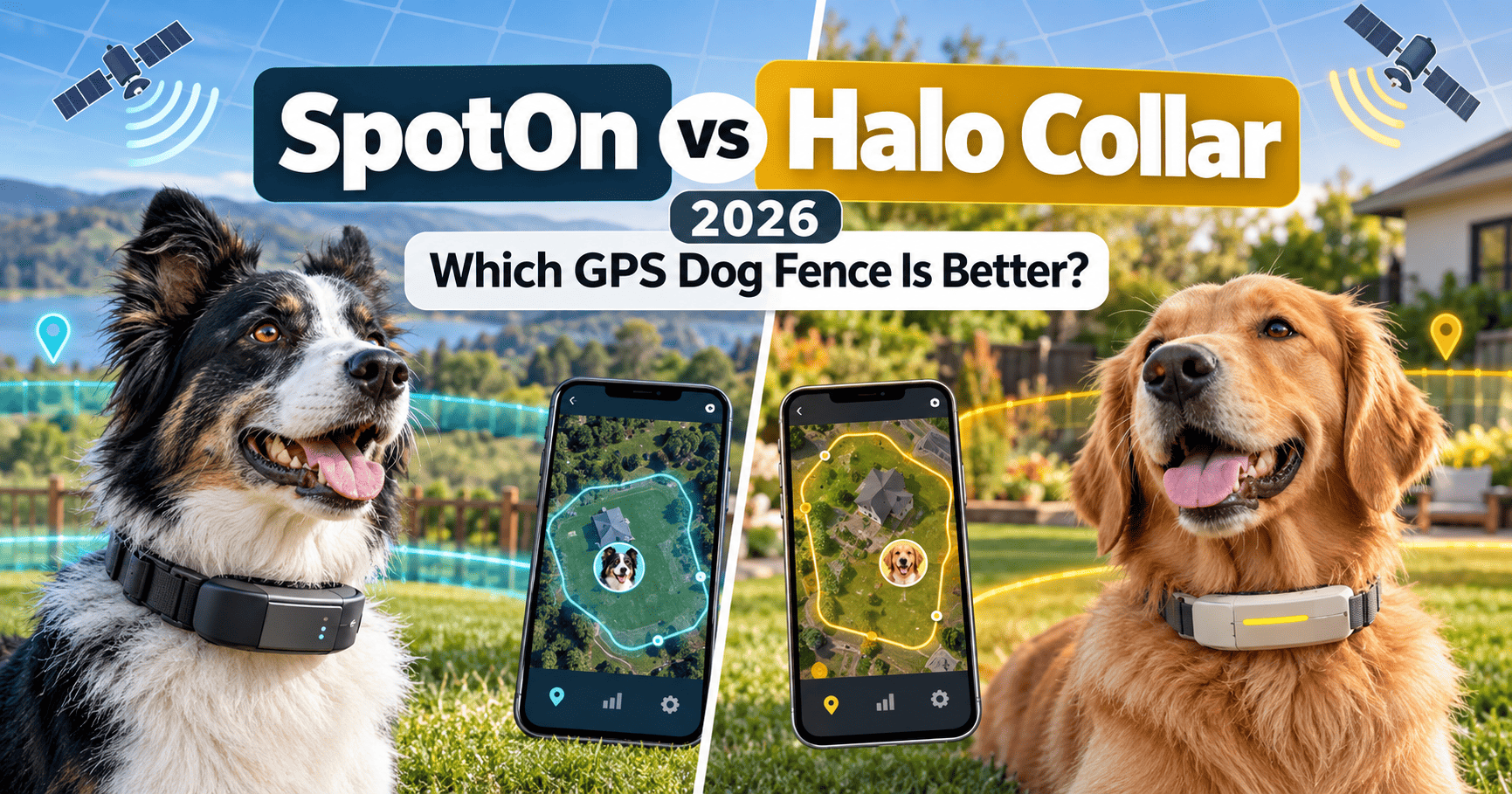
SpotOn and Halo are both premium GPS dog fence systems, but they make different trade-offs. SpotOn Nova costs more upfront and is built around flexible containment with no required subscription. Halo Collar 5 has a lower hardware price, supports much smaller yards, offers longer claimed battery life, and wraps containment, live tracking, and structured training into a required membership.
For most suburban homes, Halo Collar 5 is the easier all-around fit because of its smaller minimum fence area, broader dog-size range, and lower upfront cost. For large, rural, wooded, or irregular properties—and especially for owners who do not want a mandatory monthly plan—SpotOn Nova is the stronger choice.
SpotOn vs Halo Collar: quick verdict
SpotOn Nova vs Halo Collar 5 comparison
| Feature | SpotOn Nova | Halo Collar 5 |
|---|---|---|
| Best for | Large, rural, wooded or irregular properties | Suburban yards, smaller properties and lower upfront cost |
| Hardware price | About $999 at time of research | $599 list price; promotions vary |
| Subscription required for fencing? | No | Yes |
| Tracking plan | Optional; monthly, annual and two-year options | Required Pack Membership |
| Minimum fence size | About 1/3 acre | About 900 sq ft |
| Saved fences | Unlimited core fences | 5, 20 or unlimited depending on plan |
| Keep-out zones | Unlimited Keep Out Zones | Keep-Away Zones available through a compatible Halo Beacon accessory |
| Battery | 33+ hours with tracking; 1-hour charge | Up to 48 hours; 1-hour charge |
| Water resistance | IP67 | IP67 |
| Dog size | About 15+ lb; neck 10–26 in | 10+ lb, 5+ months; neck 8–30.5 in |
| Feedback | Tones, vibration, optional static | Sounds, vibration, optional static |
| Training support | In-app program + free 1:1 virtual trainer session | In-app training + live support and trainer resources |
| Warranty / trial | 1-year warranty; 90-day returns | 1-year warranty; 90-day satisfaction guarantee |
The biggest difference: SpotOn does not require a subscription for containment
This is the clearest dividing line between the two systems.
SpotOn Nova can create and use its GPS fences without a paid plan. SpotOn says core containment features—including unlimited fences, Keep Out Zones, Home Zones, Forest Mode, and Off-Grid Mode—work without a subscription. A paid tracking plan is optional and adds live location, escape alerts, low-battery notifications, activity data, manual feedback, and app-based recall features.
At the time of research, SpotOn listed tracking at $9.95 per month, $8.49 per month when billed yearly, or $7.49 per month on a two-year billing option.
Halo requires a Pack Membership Plan. Halo states that a plan is required to activate and maintain GPS services, cellular connectivity, and virtual fences. Its current tiers start at $9.99 per month. The number of available virtual fences varies by tier: Bronze includes 5, Silver includes 20, and Gold includes unlimited fences.
That makes SpotOn unusually attractive if you mainly want containment and do not care about seeing your dog’s live location in the app. Halo’s lower hardware cost can still make it cheaper initially, but you should include the required membership when comparing long-term ownership.
GPS accuracy: both make strong claims, but the numbers are not directly comparable
Accuracy matters because a GPS fence has no physical wire in the ground. The collar estimates where the dog is relative to a digital boundary, so GPS drift, trees, buildings, terrain, antenna design, and satellite conditions can affect performance.
SpotOn says the Nova Edition is accurate to under five feet and uses an active dual-band, dual-feed antenna, dual-band receiver, motion-sensor inputs, and access to a network of 151 satellites. SpotOn also publishes results from testing performed by Spirent, a GPS testing laboratory. Because SpotOn commissioned that testing, we treat it as useful manufacturer-supplied evidence rather than a fully independent consumer comparison.
Halo says Collar 5 uses its Precision+ dual-frequency GPS system, analyzes up to 20 location updates per second, and reports outdoor GPS accuracy of under 2 feet, with its Collar 5 product page citing about 1.4 feet under its stated conditions.
We would not declare either collar the universal accuracy winner from those figures alone. The companies use different test methods and marketing metrics. The more useful buying question is whether your property gives GPS enough room to work safely.
Fence size and property type
SpotOn is better suited to acreage and unusual property shapes
SpotOn Nova supports fences starting at roughly one-third acre and extending to very large properties. Its app lets you draw or walk custom boundaries, create overlapping fences, and add Keep Out Zones inside the main safe area.
SpotOn also emphasizes Forest Mode and performance around trees, metal structures, remote areas, and large rural properties. If you own acreage, camp off-grid, manage a farm, or need several irregular boundaries, this flexibility is one of SpotOn’s strongest advantages.
Halo works on much smaller yards
Halo Collar 5 lists a minimum fence area of roughly 900 square feet. That is dramatically smaller than SpotOn’s one-third-acre minimum and makes Halo much more realistic for suburban lots.
Halo also stores fence information on the collar so containment can continue without active cellular service. Cellular connectivity is still needed for live phone tracking and alerts.
If your usable yard is small, SpotOn may simply require more buffer space than your property can provide. For that reason alone, Halo can be the better fit for many neighborhood homes.
Battery life and charging
Halo has the advantage on manufacturer-rated battery life. Halo says Collar 5 lasts up to 48 hours and can recharge fully in about one hour.
SpotOn Nova lists 33+ hours of runtime with tracking enabled, with longer runtime possible in Extended Battery Life Mode, and also uses a roughly one-hour fast charge.
Either way, these are smart collars that need a charging routine. Battery life can vary with tracking, signal conditions, activity, temperature, and feature usage. If your dog spends long days outside, Halo’s higher stated maximum gives it more breathing room.
Dog size and collar fit
Halo supports a wider range of neck sizes and slightly smaller dogs. Halo says Collar 5 is intended for dogs over 10 pounds, at least five months old, with neck sizes from 8 to 30.5 inches.
SpotOn Nova is designed for dogs around 15 pounds and up with neck sizes from 10 to 26 inches.
For toy breeds and very small dogs, neither should be chosen only by weight. The collar needs to fit securely, sit in the correct orientation, and remain comfortable for the dog. Halo has the broader published fit range, but owners near the minimum size should still confirm actual collar dimensions and fit.
Training and boundary feedback
Both systems require training. Buying a GPS fence, turning it on, and immediately letting a dog roam unsupervised is not an appropriate setup process.
SpotOn training
SpotOn uses a tone-first sequence. As the dog approaches the boundary, the collar issues two warning tones, followed by vibration and an optional static correction if enabled. SpotOn says static is not applied when the dog is returning toward the safe area.
The company provides an in-app training program developed with certified trainers and offers customers a free 30-minute one-on-one virtual training session.
Halo training
Halo uses three levels of prevention feedback—Warning, Boundary, and Emergency—and also includes encouragement cues such as Whistle, Good Dog, and Come Home. Feedback can use sound, vibration, or optional static.
Halo’s training program is built into its ecosystem and is one of the product’s biggest differentiators for owners who want a more guided process. Halo also offers live support and training resources through its membership.
Neither system requires static as the only way to train. Both brands describe static as optional and allow sound/vibration-based configurations. The right setting depends on the individual dog, and training should focus on teaching the boundary cues rather than relying on correction alone.
Live tracking and escape alerts
Both collars can function as real-time GPS trackers, but the subscription model differs.
With SpotOn, live tracking is an optional upgrade. A tracking plan adds location viewing, automatic breach alerts, escape reports, activity monitoring, heat maps, manual feedback, low-battery notifications, and recall tools.
With Halo, live tracking and cellular connectivity are part of the required Pack Membership ecosystem. Halo also provides activity information depending on the selected plan.
If you already know you want live tracking every day, Halo’s required plan is less of a drawback because you would likely pay for cellular tracking either way. If you only want containment, SpotOn gives you the option to skip the recurring fee.
For owners who only need tracking—not active GPS containment—our Best GPS Trackers for Dogs guide covers simpler alternatives. You can also compare tracking-focused systems in our Fi vs Tractive vs Petcube comparison.
SpotOn vs Halo Collar cost over time
SpotOn’s biggest weakness is obvious: the collar itself costs substantially more upfront. The Nova Edition was around $999 during our research.
Halo Collar 5 carries a lower list price of $599 and is frequently promoted below that price, but Halo requires an ongoing membership. The lowest current membership starts at $9.99 per month.
That means the cheaper option depends on how long you own the system and which features you use. A SpotOn owner who never adds live tracking pays more on day one but avoids a mandatory monthly fee. A Halo owner pays less upfront but continues paying for membership as long as the collar is active.
Do not compare only the checkout price. Calculate at least two to three years of expected ownership, including the plan level you actually need, replacement accessories, and additional collars for multiple dogs.
Waterproofing and outdoor durability
Both SpotOn Nova and Halo Collar 5 carry an IP67 rating. In practical terms, that means they are designed for rain, mud, splashes, and temporary water exposure within the limits of the rating.
SpotOn specifically markets Nova for rough outdoor use and says the newer generation uses upgraded materials and improved cellular reception. Halo likewise positions Collar 5 as a rugged all-weather smart collar.
If your dog swims frequently, rinse and dry the collar as directed by the manufacturer and inspect the contact points and strap regularly. Waterproof does not mean maintenance-free.
Pros and cons
SpotOn Nova pros
- No subscription required for core containment
- Unlimited core fences and Keep Out Zones
- Strong fit for acreage, woods and irregular properties
- 33+ hour stated battery with tracking
- One-hour charging
- IP67 waterproof rating
- Optional live tracking plan
- Free one-on-one training session
SpotOn Nova cons
- High upfront hardware price
- One-third-acre minimum is too large for many suburban yards
- Not designed for the smallest dogs
- Live tracking still requires a paid plan
Halo Collar 5 pros
- Lower upfront hardware price
- Works with much smaller fence areas
- Up to 48-hour stated battery life
- One-hour rapid charging
- Broader neck-size range
- Structured training ecosystem
- Real-time tracking included through membership
- IP67 waterproof rating
Halo Collar 5 cons
- Membership is required
- Fence count depends on plan tier
- Long-term subscription cost adds up
- Some advanced benefits require higher plan tiers
What to check before buying either GPS fence
- Measure the usable area: confirm that your safe zone meets the system’s minimum fence size after leaving a generous buffer from roads and other hazards.
- Measure your dog’s neck: use the manufacturer’s fit range rather than choosing by breed or weight alone.
- Decide whether you need live tracking: SpotOn containment works without a tracking plan, while Halo requires an active membership.
- Budget beyond the collar: compare at least two to three years of membership costs, accessories, and additional collars if you have multiple dogs.
- Plan for training time: neither system should be treated as an instant, no-training replacement for a physical fence.
- Evaluate nearby hazards: if a few feet of GPS variation would put your dog near traffic, cliffs, water, livestock, or another serious hazard, a physical barrier may be the safer choice.
Which GPS dog fence should you buy?
Choose SpotOn Nova if: you have a large, rural, wooded, or oddly shaped property; want unlimited core fences; and strongly prefer not to pay a required monthly subscription.
Choose Halo Collar 5 if: you have a smaller or suburban yard, want lower upfront hardware cost, value longer stated battery life, have a smaller dog within Halo’s published fit range, or prefer a more integrated membership and training system.
Our overall take: Halo Collar 5 is the better fit for more typical suburban households, while SpotOn Nova is the more compelling specialist choice for acreage, difficult terrain, and owners who prioritize subscription-free containment.
When neither GPS fence is the right choice
A GPS fence does not stop other dogs, wildlife, children, vehicles, or strangers from entering your property. It also cannot physically block your dog if the system is used incorrectly, the collar is not charged, the fit is wrong, or training is incomplete.
A physical fence may be safer if your property borders a high-speed road, your dog has a strong escape history, predators are a concern, local rules require a physical barrier, or you need to keep outside animals and people away from your dog.
For travel, both systems can be useful because virtual boundaries can move with you, but never assume a new location is safe just because a fence can be drawn there. Check traffic, terrain, wildlife, local leash rules, and hazards first. Our Dog Road Trip Checklist covers additional travel-safety basics.
Frequently asked questions
Does SpotOn work without a subscription?
Yes. SpotOn says core GPS containment, unlimited fences, Keep Out Zones, Forest Mode, and Off-Grid Mode work without a paid plan. A subscription is needed for features such as real-time phone tracking, breach alerts, activity data, and certain remote controls.
Does Halo Collar work without a subscription?
Halo requires a Pack Membership Plan to activate and maintain GPS services, cellular data, and virtual fence functionality. Plans currently start at $9.99 per month.
Which has better battery life, SpotOn or Halo?
Halo lists up to 48 hours for Collar 5. SpotOn lists 33+ hours for Nova with tracking enabled, with longer runtime possible through its extended-battery mode. Real-world battery life varies with usage and signal conditions.
Which is better for a small yard?
Halo. Halo Collar 5 supports fences around 900 square feet, while SpotOn Nova requires roughly one-third acre, so Halo is much more suitable for many suburban properties.
Which is better for a large rural property?
SpotOn is particularly attractive for acreage because it supports very large custom fences, unlimited core fences, Keep Out Zones, Forest Mode, and off-grid containment without requiring a subscription.
Do SpotOn and Halo use static correction?
Both support optional static feedback in addition to sounds and vibration. Both companies also provide training guidance intended to teach the dog to respond to earlier warning cues rather than relying only on static feedback.
Can a GPS dog fence replace a physical fence?
It can provide containment for some trained dogs, but it does not create a physical barrier. It cannot keep other animals or people out, and owners should leave safety buffers around roads and other hazards.
Related GPS and safety guides
Sources & update notes
This article was researched in October 2026 using current manufacturer documentation. Prices, membership tiers, promotions, firmware features, and product specifications can change. Manufacturer accuracy claims are not directly comparable because test methods differ.
- SpotOn — Nova Edition product specifications
- SpotOn — Nova vs Omni specifications
- SpotOn — Tracking subscription plans
- SpotOn — How the GPS fence and training system work
- SpotOn — Spirent GPS testing summary
- Halo — Halo Collar 5 overview
- Halo — Collar 5 pricing and Pack Membership plans
- Halo — Collar 5 features and specifications
- Halo — Feedback system
- Halo — Product and training FAQ
Safety note: GPS fences depend on correct setup, collar fit, battery charge, satellite conditions, and training. They are not physical barriers. Supervise training, follow the manufacturer’s instructions, and use a physical barrier where a virtual boundary does not provide an adequate safety margin.